Tuesday, 11 October 2016

Four decades of green economics - what was it about 1973?

The New Economics Foundation is re-launching itself today, and I am a fellow. It seemed like a good moment to look at the history - not just of nef - but of green economics in the UK. This is the first of three blogs, to be published over the next three days...

The year 1973 was almost apocalyptic – war in the Middle East, the energy crisis, the three-day week, private armies, the imminent breakdown of society. It was all very unnerving. Nothing seemed to be working.

Perhaps that was one reason why the atmosphere was suddenly alive with alternatives. Ivan Illich published Tools for Conviviality. Fritz Schumacher published Small is Beautiful. And a former civil servant – James Robertson, the man who wrote Harold Macmillan’s ‘Wind of Change’ speech – was exiting swiftly from his job with the big banks to work full-time writing and speaking about the emerging post-industrial society.

He had been head of the Inter-Bank Research Organisation and had found himself involved increasingly with the ferment of new ideas.

“I didn’t criticise the banks, but we agreed that I’d had enough there,” he says now. “Looking back on it, I really think I was taking them for a lark because I was getting them to do things which they hadn’t hired me to do.”

At the beginning of 1973, he was on his own, with a desk and a research assistant – Alison Pritchard had been working in educational television in the USA – and expecting to be offered consultancy work. “Actually,” he says, “I found myself involved with much more interesting things, like the energy debate, alternative politics and what was then called the Conservation Society.”

In 1973, James joined the Campaign for Social Democracy, set up by Dick Taverne MP and stood against Tony Benn in Bristol South East at the February 1974 general election, immediately after the three-day week – this was a good seven years before the SDP was a twinkle in the eye of Roy Jenkins.

He won only 886 votes but garnered huge publicity from the support of the prominent Times columnist Bernard Levin.

But what really launched James on his new career was an article he wrote for the Sunday Times called ‘Can we have a non-profit society?’

Illich’s publisher Marion Boyars read it and commissioned James’ second book, Profit or People?

At the same time, Alison was co-ordinating the Turning Point network - a range of thinkers and activists who were emerging with a bundle of ideas that looked remarkably coherent, and which were to emerge over the next generation as post-industrial alternatives including the new economics.

A link was forged between James, Alison and their futurists and activists with those who were congregating around Schumacher, which was to prove the lynchpin of the emerging set of ideas.

“The first time we both met at a conference, I wasn’t very impressed by him,” says James now. “I had criticisms of him. There were certain things he missed out, like feminism, and I was surprised he didn’t go back in a revolutionary way to look at the monetary experience he had. But I came to like him.”

Alison says now: “He was a natural leader; people flocked to him – he spoke very well and he was funny.”

When Schumacher died suddenly on a train in Switzerland in 1977, James and Hazel Henderson had to step in as the main speakers on his speaking tour of Canada.

What firmly grounded the new movement was when James linked up with the former Guardian city editor Harford Thomas and wrote an ‘Alternatives Manifesto’ for the 1978 general election that was never actually called.

“I don’t think I thought of myself as a new economist,” says James now. “I was influenced very much by Illich.”It was the post-industrial society, as much as the post-industrial economy, that James was working for.

As such, he and his now wife Alison decided to set up home in the cradle of the original Industrial Revolution, in Ironbridge where they lived for five years before moving to their present home in Cholsey, Oxfordshire.

Meanwhile, the Alternatives Manifesto – with Harford Thomas blowing on the embers with his regular ‘Alternatives’ column – provided a critique that predicted many of the long-term trends that still wrongfoot the establishment today.

Tomorrow: how the New Economics Foundation began, 30 years ago this year...

See my book Cancelled! on the Southern Railways disaster, now on sale for £1.99 (10p goes to Railway Benefit Fund).

Subscribe to this blog on email; send me a message with the word blogsubscribe to dcboyle@gmail.com. When you want to stop, you can email me the word unsubscribe


Thursday, 6 October 2016

Southern Rail: mutualise not nationalise

Two different ways of holding our public services to account. One a do-or-die strike which stands in the great tradition of the Battle of the Somme, and other frontal assaults. The other an inovative, customer-led legal action.

If I was Southern Railways, I know which one I would fear the most,

What is the way out of the appalling trains service we have been served by Southern Rail and its co-franchises, Thameslink and the Gatwick Express - all collectively managed by a finance operation called Govia Thameslink, which also happens to run a railway, and doesn't do it well?

Today is Sledgehammer Day, thanks to the decision by GTR (Govia Thameslink Railway) to impose contracts on their guards so that, although they have promised to use them as customer service managers on trains where possible, they can if necessary run trains without them.

That deadline is today and it promises even more chaos (though I notice that, during strikes, GTR does actually pull out the stops to get an effective service, which they don't most days).

The two different ways of holding distant, secretive and incompetent public service operators to account are:

  • The successful crowdfunding of £25,000 to take the Department of Transport to court, which is something of a breakthrough for ordinary passengers. Barristers have already been appointed and they are currently battling to get the government to let the public see key documents - like the February remedial plan - which really ought to be in the public domain.
  • The decision by the RMT union to hold 14 days of strikes before Christmas. This boneheaded decision - equally dismissive of ordinary passengers - risks handing the government and GTR the excuse they need to pretend that this is somehow the fault of the staff. This is what they have been struggling to achieve since the services unravelled back in April.
I got involved in this crisis by having a strange conversation with  member of platform staff back in June, blogging about it, and suddenly finding that the blogs had been read by over 100,000 people.  Soon I was the centre of a storm - platform staff, drivers, guards, commuters and managers were sending me information from all over the region. I realised I would have to put it to use.

That is why I wrote and published my conclusions, along with some history - and a look back at the old Southern Railways between the wars, which were a byword for efficiency (and smoked kippers). You can buy the kindle version of Cancelled! here, the paperback version here, and other e-versions here.

What I have found so frustrating since then is that even the BBC persist in the canard that the appalling levels of service have been because of the dispute. This is what the government wants us to think - on the grounds of the mythical 'sicknote strike' in the summer - for which there was no evidence at all, except that sickness went up because of the huge strain that frontline staff were under in the chaos.

But guess what. The sickness rates went back down again and the service stayed appalling, Night after night, passengers were forced to from motionless train to motionless train, in dangerously overcrowded conditions, ministered to by a heroic staff who were kept in the dark about what was actually happening.

And to be fair, the managers were largely in the dark too. They didn't understand that their reforms, preventing depot managers from negotiating overtime locally, meant that the staff shortfall - which has remained a feature of GTR's finance-driven management - would not cover the missing shifts.

GTR has kept staffing below minimum levels. Thee are not enough drivers. Platforms staff have been made redundant. Ticket collectors have been replaced by contract staff. I even applied to be a train driver myself, and have yet to get a reply. And all the time, they hoped to solve the problem by doing what their government contract insisted they should - impose driver-only operations on all their routes, and not just the urban commuters ones.

In this sense, the collapse of services has indeed been about the dispute. There is an argument that driver-only operation is right for short services - and they have been for some time on Gatwick Express and Thameslink, which have had as a result the worst timekeeping record.  But I've become convinced that safety demands two train crew to man long distance routes and to share responsibility for safety.

The point about this dispute is not that GTR are planning to sack the guards. They have even tried negotiation, which GMT has barely done. They are not. They are retraining them as customer service managers minus a safety role, and without making them compulsory on services.

This is GTR's get-out-of-jail free card.  It means that, from today - assuming they get away with it - the principle will be in place that you don't need a guard in routes where you can't get hold of one. I've no doubt that this will eventually lead to the end of on-train staff.

My attitude to the safety question is this for long-distance routes or long trains: would you do away with a co-pilot on flights, or redesignate them as customer service managers? Would that actually be 'modernising' the airways? Would that actually be welcomed by passengers? 

The real question is what we poor put-upon commuters can do about this situation, where otherwise intelligent people, caught in the web woven in Whitehall, find themselves believing two or three impossible and contradictory things before breakfast?  Here are my suggestions.

1. Phone the BBC every time they suggest that the poor service this summer has been about the dispute. All the evidence suggests, and despite the best efforts of management and unions, that it was about serious under-staffing and poor management.

2. Get your MP to ask question in Parliament. Will the remedial plan be made public? Will they make the report by their new consultant Chris Gibb public? If not, why on earth not? Are we not affected by it? Is it not public money that is being used? 

3. Demand a repayment for season ticketholders and other stakeholders.

Otherwise, it is about backing those who are unambiguously on the side of travellers. In that situation, it is the Association of British Commuters, the people behind the legal bid to hold the government to account for their ridiculous handling of the crisis. Their success raising the £25,000 to launch a legal action is a huge achievement and a possible way forward in similar failures of service contracts in the future...

What do I want to happen? After Jeremy Corbyn's intervention, this is a good question. It seems to me that if a company messes up as much as GTR has done, then - for the sake of every other public service - the franchise must be reassigned. Especially if they have messed up for financial reasons.

Who it is assigned to in the short term is less important than where we want to get to.  The main problem with the GTR franchise has been the suffocating involvement of the Department of Transport. So it makes no sense to nationalise the franchise which can only make that situation even worse.

No, long term, the objective must be to hand the franchise over to a new mutual entity which is owned by passengers and staff, That's the idea: mutualise, not nationalise.

See my book Cancelled! on the Southern Railways disaster, now on sale for £1.99 (10p goes to Railway Benefit Fund).

Subscribe to this blog on email; send me a message with the word blogsubscribe to dcboyle@gmail.com. When you want to stop, you can email me the word unsubscribe
  

Tuesday, 4 October 2016

Monopolies and fierce Liberalism

I wrote an article in the Guardian today defending Liberalism from the otherwise invariably correct Martin Kettle, and trying to distinguish it from neoliberalism.

I made the mistake of reading about 200 comments below the line afterwards, which is always a depressing business, but could - in the midst of all the other rage - discern something of an argument emerging. There was a similar pattern going on in the Lib Dem Policy Debate Facebook page.

The argument was about how much Milton Friedman was right that most monopoly was caused by governments - and whether, therefore, we are about to be stuffed, trussed and chopped up by the new private monopolies I mentioned.

It is true that a number of the oligopolies that rule us, and most are the result of the wrong kind of regulation - the banks, the mega food corps, for example. Or is it that the government simply failed to regulate their market dominance, which would lead to a different conclusion?

But where are the market monopolies, ask my critics online - at least the ones on the right? I have a choice whether to use Visa, Amazon or Google, after all...

But do I really? I could go to huge lengths by refusing to sign Google's customer agreement or refusing to buy from Amazon when most of their high street rivals are closing their doors. I could theoretically avoid any company using Visa's payments system, but don't think I would achieve it.

It is true that, as the situation stands now, the sins of those three are the same as the sins of Christopher Columbus (the monopolistic sins anyway) - that he wanted to take a share of every transaction involving the New World (the court case took two centuries and the Columbus family lost). They want to so insert themselves into the global economy that they can rake off a percentage of everything we buy.

I don't believe that government regulation has caused that. Quite the reverse, it has failed to tackle it.

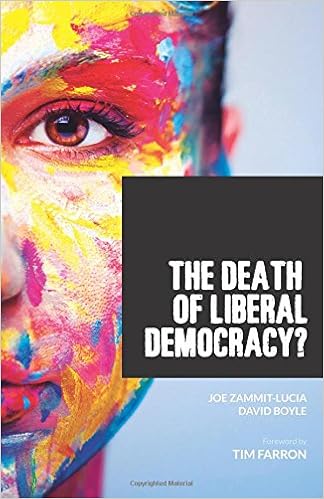
I realise I make people extremely cross when I say - as Hilaire Belloc said before me in The Servile State - that we are on the verge of a whole new kind of slavery. That is the message of my book (written with Joe Zammit-Lucia) The Death of Liberal Democracy? It is a slavery that will raise costs, lead to far worse customer service, but will have a far more dangerous effect over half a century.

It is in fact a threat that will catapult us into chains. The European Union was blind to monopoly power - the impression I got from their competition regulators was that their main concern was building up European champions to take on the American behemoths. The Liberal parties of Europe, which should have been the main opponents of monopoly, have forgotten the issue. So who will defend us?

I don't think the defence will come from Jeremy Corbyn, who it seems to me is equally blind to monopoly and giantism as the Labour Party has always been, and despite 'neoliberalism' having become the insult of choice for his supporters.

I suppose I am hoping that we can, between us, build up a political head of steam behind the attack on monopolies, public and private - but without getting too over-excited about services which have to be delivered as such. Local councils and the NHS will have to be made responsive in other ways.

And if we do that, then we will have brought a fiercer kind of Liberalism back to life.

See my book Cancelled! on the Southern Railways disaster, now on sale for £1.99 (10p goes to Railway Benefit Fund).

Subscribe to this blog on email; send me a message with the word blogsubscribe to dcboyle@gmail.com. When you want to stop, you can email me the word unsubscribe

Tuesday, 27 September 2016

Govia: a dead man walking

I write this blog about all manner of things, and especially - this is rather the purpose of it - about my books. But there is no doubt, it just electrifies when I write about Southern Railways. I try and move on but I'm drawn inexorably back - as I was yesterday.

But then two things happened yesterday, both related to the ongoing crisis at Southern, which speak directly to the themes of this blog - the appointment of a new chief operating officer at Govia Thameslink, Southern's operators, and the focus of attention on the beleaguered Seaford line.

The new COO hides the fact - which has seeped out the way things do in Soviet-style news organisations - that Dyan Crowther has moved on, to HS1. I only talked to her directly once and we got on perfectly well, though I have since heard through the grapevine that is somewhat cross with me (I won't say what she actually said).

I can understand that. I also have some sympathy for Dyan Crowther, just as I did for the equally beleaguered rail minister Claire Perry before her surprise resignation. Both were caught in an impossible situation, where no room for manoeuvre was allowed, no flexibility to see the situation as it really was, no freedom to speak the truth - or even to seek it out.

Both Dyan and Claire made serious mistakes. But, overall, they were caught in the same dishonest machine as everyone else involved in the Southern fiasco. Because GTR is a financial agglomeration, run by accountants for accountants, and also has to run a railway with at least 20 per cent fewer staff than they need. It is hardly surprising it doesn't work.

They can't say publicly that anything is wrong (except to blame the staff, of course). Anyone who has been in this situation - which is anyone in a large organisation run for accountants - will know how the lies begin to manifest themselves. They know how that corrodes from the inside, until finally all you can do is escape.

When being economical with the truth becomes an outright lie, then it undermines your health, your morale, the morale of your staff and, finally, the organisation begins to fall apart.

A case in point is the Seaford line, which had 80 per cent cuts to its service during the summer months, and has just had its service restored. But at what cost?

At least eight Southern managers have been taken away from their desks, mainly in Brighton but also from East Croydon and given a crash course in being guards.

At least one, as I understand it, has appealed on the grounds that they may be legally liable if there is an accident, especially if they know themselves to be inadequately trained. These are not volunteers. They have been told that they will be away for eight weeks - nobody has replaced them in their management responsibilities. See the leaked memos here.

It isn't clear what will happen at the end of eight weeks. There is more than a whiff of desperation about this, given that the trains on the Seaford line are not equipped for driver-only operation.

Meanwhile, there are still empty rail replacement buses running a 15-minute service from Seaford and will apparently carry on until at least the end of the week.

There is something hopeless about this. I'm reminded of the late Robert Maxwell, taking out new loans every night until all the banks were closed to him. Or Harold Macmillan talking about selling off the family silver. Or General French flinging his army cooks into the front line at the Battle of Mons. It is what happens when fundamental untruths catch up with you.

I find it terrifying and I thank goodness I don't work for GTR every day I find myself in their vicinity. There is a sense of dead man walking about them, so desperate that everything should seem normal that they have to redistribute their managers onto the front line as if what they did before was unimportant.

See my book Cancelled! on the Southern Railways disaster, now on sale for £1.99 (10p goes to Railway Benefit Fund).

Subscribe to this blog on email; send me a message with the word blogsubscribe to dcboyle@gmail.com. When you want to stop, you can email me the word unsubscribe


Monday, 26 September 2016

Commuters' lives matter

I realise I risk ridicule, or worse, by using a headline like this one to describe the ongoing unravelling of Southern Rail and the other GTR rail franchises.

It isn't as if GTR are killing commuters, though they may have been putting them into dangerously overcrowded situations. But commuters' lives do matter. It matters that people can rely on the trains to get home or get to work. I know in small ways what can happen when this isn't possible - children not picked up from school or very late rendezvous with the family. Sometimes it makes business meetings completely impossible. It matters.

The situation is not as bad as it was in June, but there are still problems. Even as I write (Sunday night), I see that GTR trains are running more than ten minutes late or cancelled in 23 per cent of cases.

It seems extraordinary to me that government ministers are still blaming the unions for this when, at the moment, there is no industrial action going on. My information also suggests that sickness levels are now back to normal.

The continuing failure of transport ministers to see clearly what is happening is part of the problem. You can see this kind of defence of the indefensible whenever economic mores are about to change - there was the same when the Callaghan government defended indefensible levels of inefficiency in the 1970s, when I was at university. It is the same now.

But it really is ridiculous that the Department of Transport has responded to requests for information from the legal team representing commuters with a stonewalling silence. Whose information is it? It is about public money, after all. This is what the Association of British Commuters (ABC) have said:

"Lawyers acting for the Association have written to the DfT requesting documents to confirm whether Govia is in breach of their franchise agreement;including documents referred to in the franchise agreement, the breach notice served on Govia on 7 July 2015 (which the DfT has a clear duty to publish), and the full disclosure of February’s remedial plan by which it is possible to assess whether Govia has been compliant. None of these requests have been granted, and our only response after weeks of waiting has sought to delay further any decision to reveal these documents..."

So this is what we need to find out, and I hope everyone will ask their elected representatives to ask parliamentary questions to the minister:

1. Will they be making public the remedial plan agreed with GTR in February and the other documents requested by the ABC's lawyers?

2. Will they be making public the report by Chris Gibb's project board charged with tackling the disruption on 1 September? If not, why not?

Again, whose information is it? Or is this once again the kind of business that is stitched up behind the scenes by Department officials and Go Ahead executives? Whatever happened to the customer responsiveness of privatised services?

In fact, the real problem is deeper than that, given that the RMT has unhelpfully decided on 14 days of industrial action. It does so because it appears to believe that strikes can be effective when it seems pretty clear that it just gives ministers more of an excuse to avoid the real issues.

The legal action is a crowd-funded attempt by commuters to get action when they have no industrial muscle. They are just the poor dependent, put-upon and patronised commuters - whose lives matter, as I said.

Let's just say that the mutual loathing is so strong - I mean here between management and civil servants and unions - that it rather reminds me of the Labour Party. Both mouth the same platitudes about helping the travelling public and how the other side is letting them down.  But in the end, they hate each other so much that all they really care about is doing down the other side.

GTR management have become obsessed with trade unions, and made serious misjudgements because of that back in April - one of the reasons services have unravelled. So have rail ministers. The RMT meanwhile is obsessed with the government. Both pretend to support travellers but actually, they just can't resist bludgeoning them again. Well, what else is there to do? How else do they express their rage with each other?

It is sad, shambolic and it really makes me cross.

If it makes you cross too, there are three small things we can do about it. Read my short book Cancelled!, Support the ABC's crowdfunded legal action, and get your MP to ask those two questions in Parliament.

NOTE: To add to the peculiarly Soviet information style of the whole GTR set-up, I see that they have appointed a new chief operating officer, without any mention of what happened to Dyan Crowther, who was in that post (as far as I know) until now. Perhaps we have to wait until they have airbrushed the corporate photos...

See my book Cancelled! on the Southern Railways disaster, now on sale for £1.99 (10p goes to Railway Benefit Fund).

Subscribe to this blog on email; send me a message with the word blogsubscribe to dcboyle@gmail.com. When you want to stop, you can email me the word unsubscribe
  

Friday, 23 September 2016

Are we going to be ruled by computers, or are we going to BE computers?

It is a peculiar thing about robots and fake humans of all kinds, but the motives of those involved in developing them can be deeply paradoxical.

Like Mary Shelley dreaming up Frankenstein as an act of revolutionary imagination, those involved in the debate about artificial intelligence are sometimes motivated by a need to remake humanity along more rational lines.

Or perhaps not so rational. Alan Turing, whose Turing Test I described in the Guardian today, was motivated partly by the incomprehension of those around him about the way he behaved.

And I don’t primarily mean his sense of logic, wearing his gasmask while cycling to avoid hayfever. I mean his gay lifestyle, at a time when homosexuality was illegal and frowned upon. See my short biography of him, Alan Turing: Unlocking the Enigma.

Perhaps it is no coincidence that Hugh Loebner, the delightful inventor who funds the Loebner Prize – his annual version of the Turing Test at Bletchley Park – is well-known for his advocacy of the right to pay for sex.

You can’t help wondering whether in these cases there is a dream of a different, more logical approach to human life, despite contemporary mores – whatever they happen to be. Computers can be programmed differently to our conditioning. But it is paradoxical – logical about passion...

The same goes in some ways for the feminist approach by Donna Haraway and others (see her Manifesto for Cyborgs), which imagines a new kind of human life, part human, part machine, which could sweep away those troublesome distinctions between male and female, straight and gay, human and animal.

This is not to dismiss artificial intelligence. I get suspicious of AI when the corporate giants use it. This kind of dreaming is the very roots of utopian radicalism, and always has been.

But I have been fascinated by the delusions of AI as well as its dreaming. Its advocates don’t always grasp that it is the sheer imperfections of human beings that make them human. Or beautiful or attractive or thrilling to sleep with.

So, no, Ray Kurzweil and others, virtual sex will never be “better than the real thing”, because the real thing revels in human imperfection and diversity. There is in fact no such thing as ‘hyper-real’. It is a concept without content from California.

It is the opposite of this – the Japanese concept of wabi-sabi, worn, imperfect, human – on which I based my thinking about authenticity (see my short book of essays, The Age to Come).

One of the comments below the line for my Guardian article suggests that AI may not happen, but the cyborg idea might. We may not be replaced by computers, but we might find ourselves increasingly computer enhanced.

The boundaries between computers and humans would begin to blur. I don’t particularly welcome this – and there are worrying implications – but I think they may be outweighed by the advantages.

In any case, it may just be inevitable.

As long as we keep a close eye on what is real and what is not. We have to remember that human beings and the virtual versions, the numerical approximations of humans, are completely different. There is no point in making AI seem closer by limiting our idea of the sheer paradoxical diversity of what humans can do,

Hence the name of this blog...

See my book Cancelled! on the Southern Railways disaster, now on sale for £1.99 (10p goes to Railway Benefit Fund).

Subscribe to this blog on email; send me a message with the word blogsubscribe to dcboyle@gmail.com. When you want to stop, you can email me the word unsubscribe

Monday, 19 September 2016

The critical importance of Doing Things

You have to read between the lines about this, but it appears that Theresa May’s objection to George Osborne, who she sacked as Chancellor, was partly that she felt he and his Etonian colleagues treated politics too like a game – a game of symbolism and positioning.

This was certainly true of Boris Johnson, who played around with the idea of banning tall buildings when he stood to be London mayor for the first time. He promised to do so, in fact, but did nothing of the kind in office. I suppose he thought that is what politics is all about, and he should be praised for his cleverness, but I certainly haven’t forgotten.

It is peculiar in some ways that politics is supposed to be about Doing Things or Making Things Happen, when it is usually nothing of the kind. It is about positioning, symbolism, gestures which show you are Serious About Change, which may actually have very little impact on the actual problem.

At the same time, there is a professional snobbery which is now extremely powerful about doing things. Those who strategise, or evaluate, or train, or consult, or finance, tend to look down on those who actually do stuff.

What is more, for the professional strategisers, there are grammar schools, pensions, subsidies, Oxbridge, and for the rest – well, of course they are well-provided for. Aren’t they?

So this is how I understand the latest push towards co-operation on the Left, the subject of the new book called The Alternative – and the subject of my Guardian article on Saturday as the Lib Dems gathered in Brighton. There is also a chapter which links to this in my new book with Joe Zammit-Lucia, The Death of Liberal Democracy?

The problem is that, once again, all the talk is about strategies, electoral or otherwise. None of which mean anything unless the various divided parties actually DO something themselves.

We have to use our political institutions to make things happen.

That sounds obvious, but it isn’t. Some opposition parties I might mention regard Parliament as a showcase for themselves as an alternative government. They tend to avoid winning votes in case it undermines the case for a general election victory that would put them in charge.

All too often, the opportunities to reach out across party lines, to co-operate to change the law in Parliament and beyond, get stymied because of obscure and irritating rivalries between the opposition parties – and because their priorities and strategies are different, and because actually they prefer strategising and campaigning pointlessly to doing.

Yet the government only has a slim majority. Imagine we could agree across party lines to use Parliament for shared objectives.

We might not be able to impact on the big symbolic policy areas – shifting the NHS or changing fiscal priorities, but we can do something. As long as it can attract MPs across party lines.

If we want to break up RBS and turn it into local lending institutions, we could hammer out a cross-party strategy to achieve that. If we want all public service contracts in the public domain, an end to commercial confidentiality for public services, we could do that too.

It might sound unexciting. It might stretch parliamentary conventions. There will be squabbles about who can claim the credit. But if we can achieve things together – then and only then can we move forward to any kind of electoral arrangements.

But I’d go further. Political salvation lies in understanding that everyone, no matter how poor, how ill, how old or how young, has a basic human need to feel useful.

By coincidence, there is also an almost limitless need – not for strategies or management – but for the human skills, that face-to-face ability to give time, that practically everyone possesses. What we lack are the local institutions, largely informal, that are able to bring those two together – the need and the time.

It isn’t just politicians who need to Do Things. Everyone needs to feel the sense of achievement that doing something gives them. Politics must steer radically away from being a spectator sport that attracts those who like to watch and those who want to be watched. It needs to find ways that everyone can make a difference, in small ways, and to draw some purpose in life from doing so.

See my book Cancelled! on the Southern Railways disaster, now on sale for £1.99 (10p goes to Railway Benefit Fund).

Subscribe to this blog on email; send me a message with the word blogsubscribe to dcboyle@gmail.com. When you want to stop, you can email me the word unsubscribe