Monday, 14 September 2015

Time to dump the Labour way of campaigning

Jeremy Corbyn's election as Labour leader has an end-of-era quality about it, perhaps the first Labour leader with something to say for a good two decades, whether one agrees with him or not.

His first public pronouncements have a strange Miliband-esque quality about them, as if the rhetoric is so much about 'change' that you forget to wonder what kind of change he is talking about, and end up none the wiser.

Most of his reported positions seem pretty retro so far: they remind me of my university days.  On the other hand, he does have a number of important contributions which are genuinely new - more on that another day.

The central political problem for the UK - because this affects everyone - is that Labour is too big to kill off, but too futile to take power. Their main role has been to prevent anyone else taking authority away from the Conservatives, and their main policy role - at least under New Labour - has been to prevent new thinking seeping dangerously into the mainstream.

I think I agreed with every word of Martin Wolf's analysis in the Financial Times:

"Land-use planning and land taxation, housing, the finance of local government, taxation of inheritance and the structure of taxation — all cry out for reforms. So does the operation of essential public services, as Mr Blair realised. I would argue, as well, for stronger policies in support of innovation and a focus on the huge risks to the economy of its dependence on soaring private debt. Yet in practice an opposition arguing for such radical reform appears inconceivable. If it were to be radical in such a way, it would probably be as unelectable as Mr Corbyn’s version. It is depressing to accept that a complacent government and an unelectable opposition are what the country must now expect..."


For many people who regard themselves as basically on the Left, as I do, much of what passes for Leftish dialogue is pretty infuriating.

It is always demanding that each and every dysfunctional institution has to be 'defended', though they are so often ineffective or overpaid or both.

It is always analysing who should be 'offended', as if language provided the real threat to civilisation rather than disastrous economics and greed - and grinding out the rage on Twitter or below the line comments in the Guardian.

It is deeply conservative, forever on the back foot, defending the social democratic compromises of the past, but knitting together no practical visions of the future - and especially not economic ones.

So often bitter, so often cross, so often offended, so cynical, so obsessed with the pointless images of generations gone by - meaningless slogans and chanting demonstrators. Yes, I find it hard to warm to the Labour Party's Left, any more than I can warn to their indefensible Right.

But there is one problem above all that we really need to tackle, because it is liable to get seriously in the way of cross-party co-operation.  We have to change the way Labour campaigns on issues.

Labour takes up issues because it makes them more electable, not to make things happen.  Quite the reverse, the best outcome in a Labour campaign is to lose - and to make people angrier with the government.  They don't take up issues to change the world.

That is the debilitating death-grip which Labour holds over the third sector. It means our campaigners have not learned to win, as American campaigners do. Our campaigners model themselves on journalists - they aspire to making a big fuss and getting the opposition to commit to change after the election. American campaigners model themselves on lawyers. They don't just sloganise on demonstrations, as if this was the October Revolution - exercises in futility - they change the world.

It explains just some of the hopelessness and cynicism about campaigning on the Left. The great campaigners, like Des Wilson, campaigned to win. If the Left is going to recover, they are going to have to realise - for more reasons that one - that Labour may never be in government again. We can't wait around for them any more.

If we're going to campaign, we must campaign to make things happen. If we campaign, it must be the antidote to futility, not a cynical embedding of it.

It means an end to the pointless symbolism of revolution. It means consciously and deliberately shifting to campaigning by doing stuff, by making things happen, by encouraging everyone to realise that - even in the way they spend their money - everyone is more powerful than they think.

Subscribe to this blog on email; send me a message with the word blogsubscribe to dcboyle@gmail.com. When you want to stop, you can email me the word unsubscribe.

Thursday, 10 September 2015

Institutions are like ancient trees

Isn't it peculiar that, the more the government machine talks about 'evidence-based' policy, and the more the political parties follow suit, the more technocratic they become.

Find out more in my original attempt to intervene in the debate about evidence-based policy (if there is one) in my book The Tyranny of Numbers.

There is now a great deal of evidence about the impact of trees on the lives of people living in cities, mainly from Dutch research (no coincidence there since the Netherlands is probably the most densely populated nation in Europe). This is especially so for people with mental health issues. Trees keep people calm, help them to recover from illness faster. It isn't just a nice but irrelevant aspect of public policy: people need green space around them to stay sane.

One glance at the rising concrete blocks around East Croydon is enough to demonstrate how little this means to policy-makers. Where are the children going to play? Where are people going to see anything green?

The sad truth is that, for all their talk of evidence-based policy, many government institutions seem stuck in the technocratic 1940s, when your average architect swallowed Le Corbusier's mantra that a house is a machine for living in and little more.  We are building in the next generation of soulless suburbs and the mental difficulties that will inevitably follow.

Yet when you see a tree that is really ancient, there is a kind of frisson - a connection with the past - that goes way beyond the evidence.  Take for example the ancient mulberry tree in Bethnal Green (thank you, Sally!).  This is what the website Spitalfields Life says:

"Imported from Persia by James I in the sixteenth century, it is more than five hundred years old and once served to feed the silkworms cultivated by local weavers. The Mulberry originally grew in the grounds of Bishop Bonner’s Palace that stood on this site and an inkwell in the museum of the Royal London Hospital, made in 1915 from a bough, has a brass plate engraved with the sardonic yarn that the Bishop sat beneath it to enjoy shelter in the cool of the evening while deciding which heretics to execute. My visit was a poignant occasion since the Mulberry stands today in the grounds of the London Chest Hospital which opened in 1855 and closed forever last April prior to being put up for sale by the National Health Service in advance of redevelopment..."

Ancient trees have a kind of mystical quality about them, connecting us - via a living thing - to the distant past. 

I have no problem with institutions being closed, if they are the wrong ones. But institutions are living things, and they make civilisation possible, in both cases just like trees. And neither trees not institutions are really safe in the myopic and data-driven worlds of the NHS estate departments.

Subscribe to this blog on email; send me a message with the word blogsubscribe to dcboyle@gmail.com. When you want to stop, you can email me the word unsubscribe.

Wednesday, 9 September 2015

Don't devolve drone decisions to the data

I went to the Dulwich Picture Gallery to see the Ravilious exhibition over the summer (very good it was) and happened to catch my eight-year-old fiddling with their online comments machine.

Creeping up behind him, I saw he had written: "I likd the nacked womens (sic)" (the gallery is known for its acres of seventeenth century flesh). I chuckled a little about this until it struck me that he would have had to sign in with an email to write a comment.

"What email did you use?" I asked, and rather hopefully: "Did you make one up.?"

"It's OK, Daddy," he said. "I used yours."

I mention this slightly embarrassing blot on my otherwise untarnished online record as a way of saying that not everything you find online is necessarily what it seems. It may be, of course, but often it isn't.

So if commenting on 'nacked womin' had somehow some kind of terrorist significance, and I had been in another country at the time, I might have expected to be killed by an RAF drone without further ado.

This is not to cast doubt on whether the extra-judicial execution just carried out by the government in Syria was necessary. It probably was. Certainly, if the security services had known about a threat to the Queen and had failed to act, they would have deserved to have been bundled out of office.

But two things still worry me.  Since John Gummer fed a beefburger to his daughter to prove how safe they were, at the height of the Mad Cow Disease epidemic, and since Tony Blair talked about the 45 minutes before Iraqi weapons of mass destruction would land, I have been sceptical about what successive governments have told me.

I believed both those assurances. I now believe very little.

The second thing is the sheer inaccuracy of data and online evidence. So if we devolve our decision making and intelligence to machines, robots, drones and data, then mistakes will be made. If we start bombing people on the basis of data, rather than knowledge, we will eventually reap the whirlwind - as the Americans appear to be doing with their drone strategy.

Years ago, I remember a Punch cartoon with an NYPD plane flying over New York City and dropping bombs.  The policeman in the cockpit is saying: "Don't worry, we're bound to be hitting someone who's breaking the law."

What a good thing our own government would never behave like that.

Because we are already rendering our institutions stupid by automating the wrong functions. The purpose of government data policy is too often just to replace professionals, not to improve services. That is one reason why so many of the cost-cutting has led to increased costs, but that's another story.

Data looks objective but, all too often, it depends on definitions which are endlessly malleable. Or worse, it depends on some kind of programmer making these lines of delineation on the fly. One of the most serious defects of public service policy is the over-reliance on wobbly, tweakable data which is busily deluding those at the top of every hierarchy. For some reason, governments are more deluded by data than almost anybody else.

Let's just make sure that the most important decisions - like when to raid and when to pull the trigger - don't get automated in the wrong way.  Not just for their sake, but for ours.

Subscribe to this blog on email; send me a message with the word blogsubscribe to dcboyle@gmail.com. When you want to stop, you can email me the word unsubscribe.


Tuesday, 8 September 2015

Big versus small: whose side is Corbyn on?

I have no idea whether Jeremy Corbyn will transform the great lump we know as Her Majesty's Official Opposition. I know he deserves to - though I expect the energy he has brought to the campaign is as much as a surprise to him as it is to everyone else.

But of course his arrival on the political frontline is a bit of a headache for the Lib Dems, hence the peculiar series of anonymous briefings which Caron Lindsay got exercised about on Lib Dem Voice. Could the Lib Dems really try to outflank Corbyn on the Left? Well, that really begs the key question here - what does it mean to be Left now?

That is going to be the issue between the two competing parties of the Left, even sharper if Corbyn wins. And don't tell me we can solve the problem by "sticking to the centre ground" either. Where is that, exactly, if the definition of 'left' is in dispute?

What is left unsaid, and perhaps implied in this flurry of nerves, is that - actually - Corbyn is rather attractive to some Lib Dems. Partly of course because he's such an outsider, which always appeals to the Liberal romantic spirit. Partly because what he says is so old-fashioned that it appears radically daring.

But let's not beat around the bush. In two very important ways, Corbyn is not talking Liberalism. Maybe we should spell these out, because they may provide a clue about the way forward.

First, he isn't interested in diversity in the Liberal sense. He is talking diversity in the socialist sense, which is a demarcation of uncrossable boundaries between identities - if you are Scots, you can't also be English. If you are gay, you can't really see the world through the eyes of the opposite sex and vice versa.

This is postmodernism and I don't think it is how Liberals think. There is no space for multiple identities - true diversity - in the world of socialist puritans. No idea that you could be English and Scottish and from Sussex and European and carry dual nationality somewhere else, and understand all of them. That is diversity. It is the very opposite of identity politics.

It is also increasingly urgent, as the economy drives out diversity everywhere. Fewer energy suppliers, fewer seed manufacturers, fewer farmers, and all the time we get more and more dependent on the most powerful of them.

And if you don't agree with me, try having a fight with Google and see who wins...

Which brings me to #2.  If the twentieth century was spent working out the conflict between capital and labour, between public and private, the twenty-first century seems to be gearing up for a titanic clash between big and small - big institutions against small ones.

It is a battle over the meaning of efficiency, about whether economies of scale outweigh diseconomies of scale, or vice versa. It matters - and it matters to me particularly because it puts the Liberal critique of institutions centre stage again.

Now, ask yourself, whose side would Corbyn be on? The point is that he is on the side of big against small.  His rhetoric, and what we know of his policies, imply vast, amorphous and slightly tyrannical institutions, public ones it is true - but really I see very little distinction in practice between the public monsters and the private monsters.

They are all like dinosaurs, self-serving, gently eating their own tails.

Now, here's the crucial bit. Ask yourself, if Corbyn was genuinely interested in diversity - and if he could swap his giantism for something smaller, and therefore more beautiful (and effective), would he still be a socialist? The answer, it seems to me, is that he would be a Liberal. And he isn't.

I know that there will be problems for Lib Dems puzzling out how to deal with a far left Labour Party. It threatens a fearful re-run of the 2015 election, as fearful floating voters hold their noses and vote for the status quo.  But there will be one great benefit: Liberals will have to think a bit more clearly about what Liberalism is.

Subscribe to this blog on email; send me a message with the word blogsubscribe to dcboyle@gmail.com. When you want to stop, you can email me the word unsubscribe.

Monday, 7 September 2015

Refugees and Policy Wonk's Disease


My children need three square meals a day
O Lord God
And I ain't gonna be treated this way


Woody Guthrie, of course, in the aftermath of the Dust Bowl, and the great movement of the poor and ruined westwards to the California line. More of him another day. There is something of The Grapes of Wrath about what is happening in the interface between Europe and the middle east, but I suspect that even John Steinbeck never dreamed of what is about to emerge.

This is a difficult blog post to write. I've found, over the last few weeks, that my policy head has been at war with my moral heart. I've been staggered at the impact of the photos of the little boy drowned in the beach - heavens, it has even shifted the callous heart of News International.

It is easy to be moralistic about this, but - if I'm going to tell the truth - the photo shifted me too.

"It takes a civilised man to be deeply moved by statistics," said George Bernard Shaw and I realise now that, actually, I wasn't nearly civilised enough.  The horror of what is happening has finally come home to me. I wish I could have said that I understood for weeks, if not months, but it took a photo.

I'm the father of two sons myself and I wasn't immune.

So now I've been trying to puzzle out why it took me so long to grasp the human reality, and the tentative answer is that I have Policy Wonks Disease. I can't feel strongly about anything until I know what the policy solution is.  In this case, it is an even bigger struggle.

I have felt for some time that Europe was set for a massive influx of refugees, the like of which we may not have seen - certainly since World War II, but possibly not for some centuries before. I'm not sure there is a precedent for what is about to happen.  What is happening so far is a trickle compared to what will happen.

So I've found myself frustrated, not just with Cameron's 'stonewall' approach, but with the idea from the Left that somehow the solution was just about letting more people in.

This isn't just a crisis, it will be the crisis - and especially for the European Union which will somehow have to find a way of assimilating millions of people without unleashing a fierce reaction from their permanent communities, and hammering out some kind of policy that could conceivably pacify the middle east.

It hardly needs saying that it seems possible, even likely, that the EU will break under the strain.  But that somehow isn't the end of the problem.  This is the European crisis, emerging from the disastrous European involvement in the region from the Balfour Agreement to the American invention of the Mujahiddin.

Perhaps it goes back to the fall of Granada, the defence of Vienna and the Crusades. Perhaps this is the culmination of a very long story indeed that stretches back before Islam gained any kind of foothold. And because of the disastrous invasion of Iraq, we are now powerless to intervene militarily.

The sight of Cameron flip-flopping from one year to the next about which side in the Syrian conflict it is imperative to intervene on kind of makes the point. We can only now intervene in support of the cause to heal the rift in Islam by backing someone from there, with a message powerful enough to unite the middle east.

That message now lacks conviction. It lacks a representative. It lacks content. It is about as distant as it possibly could be right now.

In the meantime, it is quite impossible politically to solve the problem within Europe, however many families Europe takes in.

This is a prime example of Einstein's principle that you can't solve a problem on the same level that it was created. Our economic structures are wholly unsuitable for what is coming, which will make the next few years increasingly painful.

There may be action on safe havens we can take, but that will just be sticking plaster. But when I find myself thinking about what might possibly work - long-term - I'm imagining that we may have to remake the middle east in Europe, and from there forge the kernel of resistance to ISIS and all the other uncivilised regimes that are emerging.

To see this from another angle, we have to go back to the generation of Florentine philosophers, poets and geographers around the Medici who first 'discovered' the new continent of America for Europe. They believed in a strange dream which might help us now.  Read more in my book Toward the Setting Sun.

It was that Christianity, Islam and Judaism were at their roots the same, and that behind all three lay a kernel of divine truth that would allow them to be forged together in a new era of peace.

It was an idea they had borrowed from some of the Greek Orthodox churchmen who had come to Italy before the fall of Constantinople. In fact, the Papal Secretary George Trapezuntius, in Naples when he heard of the downfall of his own city in 1453, had written an urgent letter to the Sultan, urging him to work for the unity of the two faiths:

“If someone were to bring together the Christians and the Muslims, in one single faith and confession, he would be, I swear by heaven and earth, glorified by all mankind, on earth and in heaven, and promoted to the ranks of the angels. This work, O admirable Sovereign, none other than you can accomplish.”

Perhaps, by taking in the poor, hungry huddle masses of the middle east, yearning to be free - in an effort unprecedented in the modern world - we might shape this new spiritual understanding to underpin the kind of peace so many millions yearn for.

Subscribe to this blog on email; send me a message with the word blogsubscribe to dcboyle@gmail.com. When you want to stop, you can email me the word unsubscribe.


Thursday, 3 September 2015

Businesses need economic change too

I had what was, for me at least, a respectable flurry of hits on Tuesday when I agonised in public about whether the Lib Dems were becoming a pressure group.

If they are doing so, it is partly  for a reason which is peculiar to them - Liberals tend to be blind to the problems of money, just as socialists tend to be blind to the problems of centralised power.  It is also partly for a shared reason: the Left has become terrified of economics, because it used to be regarded - in the peculiarly lame jargon of the day - as a 'shield' issue. In other words, it was a topic they could make no vote-winning contribution about.  All they could do was defend themselves.

As the years went by, their economic muscles atrophied. Then they stopped seeing economics issues at all - so it is hardly surprising that the only way of thinking about economics was the mainstream one, imported from the American thinktanks and spread to the world.

All this is about to change, of course.  Not just because Jeremy Corbyn has exhumed an approach to economics that most people had assumed had long been dead and buried (and may still turn out to be).  But also because, every 40 years, there is a major shift in mainstream thinking.  We are due for ours in about four years time.

What holds us back isn't that the disastrous record of the current way of doing economics, or the pretty disastrous way of doing economics that preceded it, has not been recognised yet. Most thinking people can see that something has to change.

What holds us back is that the mainstream has not yet tiptoed into the debate about what we do instead - how we make economics work for everyone. What the new world is going to look like.

Two graphs sent to me in the past 36 hours make the point for me.  The first (thanks, Rob) shows what has been happening to global income distribution, as we all descend into semi-slavery:


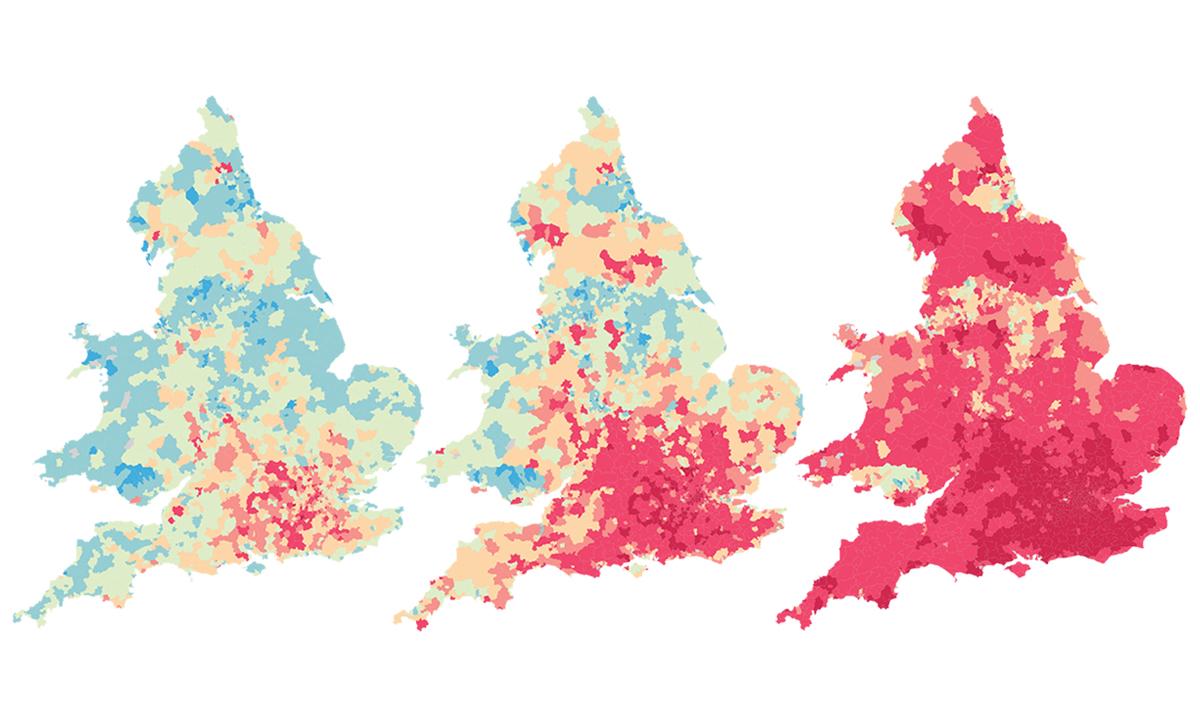
The second (thanks, Isabella) is about where people on a median income can afford to buy a house, and it is from the Guardian (an amazing interactive map, with 2014 on the right, and the red are no-go areas):
Embedded image permalink
Now, even under Corbyn, Labour seems unlikely to join in this debate about what next - either for fear of the new approved hymnsheet or, more traditionally, for fear of frightening the horses by appearing to be 'anti-business'.

This seems to me to be a profound misunderstanding.  As far as I can see, business is as concerned about these trends as everyone else.  How will they be able to operate if the vast majority of the nation can't afford to buy a house or put down roots? How will they be able to sell when their only clients will be the handful of super-rich?

I don't understand where the problem lies. Does criticising the status quo mean being anti-business? Most businesspeople I know are just as critical as I am.

Most are sceptical that welfare or Fabian-style redistribution is the solution, but then so am I...

I can understand why Labour has to feel it must spend energy in public assuring people that they are still committed to the good old business model of the 1950s - but why, with some notable exceptions, do the Lib Dems stay so silent?  And the real question: can they be the political crucible which forges a way forward?

Subscribe to this blog on email; send me a message with the word blogsubscribe to dcboyle@gmail.com. When you want to stop, you can email me the word unsubscribe.

Tuesday, 1 September 2015

Are the Lib Dems becoming a pressure group?

What distinguishes a political party from a pressure group?

Is it the breadth of their agenda? Not really, look at some of the new campaigning outfits, like the irritating 38 Degrees.

Is it that they are standing for elections? Not really, pressure groups can and do so.

Is it that they have to be registered as a political party? Please don't bore me with legal definitions...

No, what makes a political party a political party is that they aspire to run the country, which means that their programme has to cover all the essentials that a government might need.  They can't, for example, say - oh, we're not very interested in defence. They can't say that they are just going to assume that somehow everything about economics or business is somehow irrelevant to their great cause.

The trouble is that this is precisely what the Left has been doing over the past generation. They have been doing so for different reasons, but that has been the basic underlying problem.

The Labour Party has been ignoring economics for fear that they will be thought too radical if they mention it at all. The Lib Dems have been ignoring economics because, with a handful of noble exceptions, they can't see what it has to do with Liberalism.

Part of Jeremy Corbyn's attraction seems to me that he has disputed the basic underlying Labour agreement: don't mention business, except to praise the banks.

Because the truth is that no potential government is going to be elected if they don;t set out - in some detail - how they are going to build prosperity in the nation.

The idea that somehow you do so by making a handful of people very rich, and letting the wealth trickle down, as long since been revealed as a major delusion - but the political parties of the Left appear to conspire not to mention this.

They talk about shuffling the deckchairs a bit. They talk a great deal about welfare, and these are not unimportant, but that's not the core issue for government. It is about moving prosperity around, not creating it. Nor is it what people want to hear - a credible programme for the economy that underpins the majority of people's lives.

All they are being offered is the following:

  • Business as usual (broken) with Osborne or Blair.
  • A tumbledown mixture of stuff on the welfare state (most of the Labour leadership contenders).
  • A heady mix of stuff about benefits, Europe, youth services and Trident (the Lib Dem conference agenda this month).
It's fine as far as it goes, but none of this provides a way forward for the Left on economics. Labour and Lib Dems alike have preferred, for some reason, to defer to their Conservative rivals on economics and business. It is hardly surprising, in those circumstances, that - when people feel nervous about the future - they should do the same.

Of course I'm going to the Lib Dem conference in Bournemouth. I wouldn't miss it for the world. But don't let's pretend that this is a debate about any kind of programme for government.

Nothing about employment, the banks, business, enterprise. Nothing about economics, currency reform, money management. Nothing about money at all.

So, while we're there, let's try to make sure that the party tiptoes back onto the economic agenda it has virtually abandoned. Because, if I'm going to be a member of a glorified pressure group, there may be more successful ones out there I could give my money to.


Subscribe to this blog on email; send me a message with the word blogsubscribe to dcboyle@gmail.com. When you want to stop, you can email me the word unsubscribe.