Wednesday, 12 November 2014

Projecting our loss of innocence

When Arthur Miller was writing The Crucible, he mentioned to a friend as he left dinner for the evening that he was working on a play about the Salem witch trials.

She was astonished that he could see any parallel between witch trials and the McCarthyite hearings against un-American activities, going on at the time. Yet now we call both ‘witch hunts’ without batting an eye. It is sometimes more obvious with the benefit of hindsight.

These kind of frenzies emerge often with good reason, but involve a great deal of projection. I have a feeling the un-American witch hunters were projecting their own sense of betrayal – and nearly everybody in public life seems to carry one of those – onto the nation.

I wonder in a similar way whether the ferocious elements of the furore about child abuse is caused, to some extent, by people projecting their own loss of innocence onto children.

This is not to suggest that the child abuse campaign isn’t important, but it might explain the fringe elements like banning single adult males – or those who appear single – from public parks, as they have done in Telford and Weston-super-Mare.

So I’m grateful to Jonathan Calder for being the first to draw my attention to this. It is a frightening trend, not just because of its assumptions, but also because it undermines family life in its own way (if you need a child with you to prove your own innocence) and therefore makes abuse more likely, not less.

I realised more than a decade ago that the issue had the potential for tyranny of this kind, when someone I knew well told me that it didn’t matter if a few innocent people were gaoled in order to catch the paedophiles. Since another friend of mine was one of those innocent people facing gaol at the time, this was not comforting.

Important causes may always have the potential to draw out this kind of insanity. But we have to be careful, because this is also how causes undermine themselves - whenever something is considered so important taht a mere accusation is evidence of guilt.

There is a strong current in the child abuse ‘industry’, if I could call it that , which regards abuse as mainstream in family life, and justifies the treatment of children accordingly – seized in the middle of the night by police during the satanic abuse panic.

There is another strand which assumes that children will usually be better off in local authority care than at risk of abuse at home – though, historically, that is more often a case of out of the frying pan and into the fire.

Both of these get in the way of keeping children safe, because they risk changing the boundary lines of the issue. A world where single people are regarded as pariahs, or anyone who happens to have left their children or grandchildren at home, is a much more dangerous one for children.

Tuesday, 11 November 2014

How to waste a staggering £15bn

Martin Mogridge was a transport economist.  He was originally a physicist who wore long hair and leather trousers, and a cultivated air of exoticism. His interests included science fiction and Victorian eroticism, and just before his untimely death in 1999 at the age of only 59, he began studying Hebrew.

Over the previous three decades, while the major cities of the world enthusiastically demolished their slums and built massive urban highways, transport experts had been puzzling over the phenomenon of how new roads – even widened roads – seemed to increase traffic.

Economists had noticed that, if there is more road space, then people find it worthwhile to pay to use their cars, if they had one. Then public transport attracts fewer paying passengers and the fares go up or services reduce, and even more people go by car. 

Even in the 1930s, they had noticed that new roads released what they called ‘suppressed demand’. Worse, then the traffic goes faster and the buses find it more difficult to negotiate traffic streams or cross big highways. It all combined together to create what was called the Downs-Thomson Paradox, described like this:

“If the decision to use public or private transport is left to the free choice of the individual commuter, an equilibrium will be reached in which the overall attractiveness of the two systems is about equal, because if one is faster, cheaper and more agreeable than the other there will be a shift of passengers to it, rendering it more crowded while the other becomes less so, until a position is reached where no-one on either system thinks there is any advantage in changing to the other... Hence we derive one of the golden rules of urban transport: the quality of peak-hour travel by car tends to equal that of public transport.”

That was a vital clue: the speed of road transport and public transport are linked, and the journey times door to door for both are often very similar. Mogridge realised that, in London, everything depended on the speed of the underground system, which is why the traffic in London has stayed at a pretty average speed since 1900. 

If you build more roads, people go back to their cars because it is then quicker than going by underground – until the point when the speed is so slow that underground travel is faster. Then they leave their cars behind and go by tube.

The solution to speeding up the traffic is therefore to speed up the main public transport infrastructure. What’s more, said Mogridge, this works even if you take space away from cars to make room for public transport. It was the thinking that led to plans like Crossrail – the new high speed underground line across London – as well as on Zurich’s successful strategy to reduce car use based on better pedestrian access and investment in trams. 

By the end of his life, Mogridge reckoned that traffic speed could be doubled just by reducing space for cars, though it remains difficult for public officials – at least in the UK – to act on this new law of traffic management.  Read more in my book The New Economics.

What applies to London also applies to he trunk road system.  What is really staggering is that David Cameron has announced road-building plans which fly in the face of this knowledge.  In fact, £15bn worth, about which he claims:

“This will be nothing less than a roads revolution – one which will lead to quicker journey times, more jobs, and businesses boosted right across the country."

If Mogridge was right, and I think he was, the very last thing this will do is boost journey times.  It is a staggering waste of money and it seems at the very least unproven that it will boost business, except of course the business of road-building.  Road-building tends to move jobs from the poor areas to the rich areas, and rarely the other way.

Every one of those extra lanes, built at such enormous expense, will attract the road traffic to fill them again and I feel despairing of the establishment's ability to learn anything very much - and their amazing ability to keep plugging away with their money at the futile and hopeless.

It makes you yearn for austerity.  It's a pity it has got such a bad name.  At least it meant a little forethought before slinging money around at all the old shibboleths.

Subscribe to this blog on email; send me a message with the word blogsubscribe to dcboyle@gmail.com. When you want to stop, you can email me the word unsubscribe

Monday, 10 November 2014

The great system thinking battle that is to come

PictureIt is peculiar the way most of the organisations we deal with now want to prolong the agony by asking us to rate the ‘experience’ of dealing with them.

This does betray, I suppose, a kind of interest in what we think, but there is also something profoundly irritating about it – especially if it involves formal ratings. It is very rare to get this from organisations which actually provide good customer service – questions, yes (like the NHS Friends and Family Test), but ratings, never.

A friend of mine was telling me last week about a particularly irritating encounter at Santander, where they then tried to sell an insurance package in the branch and then asked them how they would rate the encounter on a scale of one to five.

If that wasn’t irritating enough, the bank counter staff then said: “It would help us if you could make it a 5.”

This led eventually to a long conversation with the manager where it transpired that they didn’t understand why everyone gave them a 4. Had they ever thought about what a 5 in customer service might look like? Apparently not, apart from their ability to perform by the rule book.

And somehow, that experience sums up the full debilitating power of the targets regime rolled out with such enthusiasm across public services during the Blair and Brown years. Because it hoovers up the available energy, imagination and flair of the organisation to make the figures look good. It transforms the customers into merely the means by which a good rating can be won.

I remember a fly-on-the-wall documentary about airport security recently where the staff focused all their attention, not on spotting potential terrorists, but on spotting the fake terrorists sent to test their attentiveness by their managers – a slightly different skill.

Imagine that same shift of resources across every public service and every service organisation, and the waste and perversity that results will be absolutely vast.  Unfortunately, it is vast.

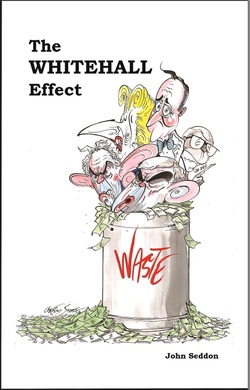
Now it just so happens that the scourge of targets in public services, the system thinker John Seddon, has a new book out this week where he turns his attention to what governments should do instead of targets.

Seddon has the most coherent critique and probably the most practical alternative. He is so enjoyably rude to his opponents, the conversations with whom he repeats throughout his new book, The Whitehall Effect, that his old newsletters were required reading in local government.

In places like Camden, they have begun to roll out Seddon style systems thinking, and with great effect. But the debate has hardly been joined – because Whitehall is well-insulated against such a fundamental critique.

He describes his first encounter with local government in the book, when Swale District Council called him in because the back office system they had been told by the DWP to put in place for housing benefits seemed to be increasing the backlog – as we now know they do.

Seddon seems to have nailed the basic problem: imperial systems, like those built by public services during the Blair/Brown years – and especially inappropriate IT systems – can’t absorb the kind of human variety they tend to get. This enormously boosts costs.

Now, Seddon’s book has been long-awaited by people like me, who agree with most of what he says, because we were hoping for an answer to the great accountability conundrum – which is this.

Without some kind of numerical measures, how are politicians going to hold services to account? And if they don’t use numerical targets, will these not just be imposed on them by the media?

Seddon’s answer is this; politicians should set the intentions of services and let managers find the best way to achieve them. This is what he says:

“Making leaders responsible for choices about measures and methods returns validity to inspection. Instead of inspecting for errors as laid down in checklists, inspectors will pose just one question: What are the methods and measures being used t achieve the purpose of the service?, and then check their validity.”

This is exactly right. But in practice, it seems to me to be only the beginning of a practical answer, because numerical systems of control are now so powerful and centralisation, driven by IT, is so intense..

I’m not saying that the solution is wrong. Quite the reverse: I think Seddon is urgently right. And The Whitehall Effect is an important book. But this remains an argument in progress and I’m not sure we have a definitive answer yet.

I’m hoping this book will force the big service managers to engage with the argument in a way they have failed to do so far – and admit that the waters around them have grown. The times they are a-changing.

But we need their involvement if we are not going to escape from one numerical cul-de-sac, only to find we have had another one imposed upon us.

Subscribe to this blog on email; send me a message with the word blogsubscribe to dcboyle@gmail.com. When you want to stop, you can email me the word unsubscribe

Thursday, 6 November 2014

The risks of investigating the banks now

It is both exhilarating and disturbing to find that the great edifice of government is moving in the directions you have urged.  Not that I am in any way influential on these - the Treasury's inquiry into digital currencies and the new Competition and Markets Authority investigation into the banking market.

But it is still disturbing.  Why are they doing it now?  Will they actually make things worse?

It isn't clear to me, for example, that the Treasury has the authority it needs to regulate digital currencies, and I am always nervous when government departments start thinking about regulating areas which require innovation - they so often go about it in entirely the wrong way.

On the other hand, I would prefer UK banking regulators to have a go at setting out a framework for new kinds of money than any other European nation.  Heaven help innovation if the Banque de France or the Bundesbank start throwing their Napoleonic weight about.

The Bank of England has already written something open-minded about the whole field.  History demands that they take their responsibility to take charge of this on behalf of the continent.  Or so it seems to me.

But I am confused about the government's decision to call in the banking market.  I am not naive enough to believe that it had anything to do with my suggestion in this blog last month.

It is true that the banks require rescuing from themselves.  The domestic banking market is no longer viable with free banking, partly because of low interest rates.  None of them can afford to move first, but - if they collude among themselves to charge - they risk going to gaol.  An investigation of this kind is precisely what they need.

In which case, why are they complaining?

The other question is this.  The investigation is going to take 18 months, over the period of the next general election when the future of banking ought to be one of the main objects of debate.  It is absolutely vital that we don't allow the parties to use this process to avoid discussing it with voters.

I very much hope that the Lib Dems will campaign on their new policy of banking with boots on the ground - and will act on it, alone or with others, after the election.  Fingers crossed.

Wednesday, 5 November 2014

We should nominate Elle for the Turner Prize

The mainstream arts world is a peculiar place.  It struggles these days, not so much for beauty in the Ruskinian fashion, but for controversy - to frame a contradiction more sharply, to act it out, to see things more clearly.

It is true that most of what is produced, even for the Turner Prize, fails to rise this far.  But then something comes along in real life that makes all their efforts redundant.

Can you imagine how a artist's career would have been made just by dreaming up and performing the bizarre dance of embarrassment by Elle, Whistles and the Fawcett Society over their sweat-shop T-shirt campaign.  How everyone in search of popularity managed to be photographed putting one on, how they checked - of course they did - the so-called supply chain.  But failed to pick up the phone to speak to someone in the actual factory.

I hope Elle and Whistles are pleased that they have inadvertently publicised the issue of sweatshops - but I expect they are still execrating each other behind closed doors.

What this whole mistake means, it seems to me, is that the gulf between trendy, branding campaigns and the real underlying economic issues is as wide as ever.

Yes, people can be photographed in a T-shirt, but they seem blind to the underlying economics - even a bit bored by it.  As if it was somehow unavoidable.  As if anything more than one-dimensional causes are really too much.

There encapsulated in this amazing installation is the central blindness of the modern world.  It would be enough to win the Turner Prize.  In fact, I'm going to see if I can nominate the Elle magazine and Whistles.

Tuesday, 4 November 2014

Why governments take so long to act

I'm a little behind with my reading, what with moving house in the summer and the constant business of navigating the remaining cardboard boxes full of books.  So it has taken until now for me to read the edition of Fortune magazine from last month about the progress of General Motors.

What I read was so fascinating and seems to me to shed light, not just on the strange business of the Home Office's failure to appoint anyone to head the historic abuse inquiry who can sustain the job for more than a few days, but the mysterious business of why governments mess up as often as they do.  Maybe even a clue about crashes like Virgin Galactic (though Branson has denied that warnings were ignored, so maybe not).

It was the strange story of GM's recall scandal involving the failure of the airbags in the Chevrolet Cobalt.  It was clear from April 2013 that the fault lay in the ignition system.  Then - nothing.  This is how the business writer Geoff Colvin put it:

"No order for an immediate recall, no report to high-level executives.  Not even the general counsel was told.  Instead ... 'the response to the revelation was to hire an expert'.  It took six months for the expert to provide his written report, which merely concurred with what outsiders had been telling GM for years: that faulty ignition switches too easily turned from run to accessory mode, disabling the airbags.".

Even then, they didn't act.  The engineer had to read and consider the report.  Then he put his views to various committees.  Finally, GM recalled the model in February this year.  They had known exactly what the problem was for nine months - and 12 years after it was clear there was a problem.

GM's new CEO Mary Barra is using the disaster - which seems to have killed about 13 people - as a way to turn GM's exhausting culture on its head, not by forming another committee but by "behaving differently every day".

One of the problems about deciding urgently important things by networks of committees - in giant corporations or in Whitehall - is that people can avoid responsibility for the decisions.  There are benefits too, but it makes change so exhausting that it happens extremely slowly - often beyond the point where it comes too late to make a difference.

Or, like constitutional reform, you wait and wait and then the committees disgorge some hastily contrived, seat-of-the-pants compromise.  I heard the late lamented Joel Barnett on the radio today, to mark his death, complaining that the Barnett Formula which still governs the fiinancial settlement for Scotland and Wales was just one of these - something to satisfy some urgent crisis at the time.  But decades ago.

So much decision making in government seems to be like that - government sometimes seems to be the sum total of every short-term sticking plaster ever cobbled together.

The bigger the organisation, of course - the more crass the management style - the worse these features tend to be.

So Mary Barra fascinates me.  As head of HR at GM, she cut their ten-page dress code down to two words - 'dress appropriately'.

It is the high risk approach to simply fly in the face of this by the way you behave.  I suspect that may be the only way to change a decision-making culture.  But could any elected politician dare?

Monday, 3 November 2014

Lib Dems, Greens must not hate/barbarians are at the gate

I was one of those young-ish activist types who took part in the extremely unofficial talks held between the Young Liberals, Liberal Ecology Group and the Green Party in the late 1980s to see if there was any basis for a re-merger.

In practice, what actually happened was that the Green Party abandoned the talks in response to their spectacular result in the 1989 Euro-elections, and - as it turned out - the Liberal Party merged with the SDP.

That probably was all for the best.  We have gone our separate ways as parties in the last decade and a half.  Everyone would agree that there are parts of the Green Party which are emphatically not liberal.  There are certainly parts of the Lib Dems which are not green.

But back in 1987 (or was it 1988?) there was a strong measure of agreement.  The main difference, as it was put to me by a prominent Green activist, was that the Liberals were more pragmatic - they compromise on the way to their objectives.

I noted this remark away rather cynically.  Just wait until they run a city, I said to myself, and we'll see how long that attitude lasts.

What I didn't understand at the time was that this division (the realo/fundi division) was absolutely at the heart of Green politics, as much as the Tories are divided between free marketeers and xenophobes or between social and economic Liberals.  The division has emerged over and over again, and disastrously, from the Hungarian Green Party to the Green ruling group on Brighton and Hove Borough Council.

All of this is a way of saying I don't agree with Caroline Lucas, the Green MP, when she dismissed the idea of any kind of electoral arrangements between the two parties, as proposed by St Ives MP Andrew George.  Because there are ways in which Greens and Liberals represent missing wings of each other's philosophy.

I like and respect Caroline.  She is a principled humanitarian, and she is quite right that we shouldn't waste time with any kind of formal electoral pact.  But I'm not sure we have the luxury of happily bashing each other when a combined Ukip/Tory force may emerge to take down the wind farms and frack us all to kingdom come.

She is quite right, it seems to me, that the Lib Dems in office have compromised too much with nuclear subsidies (I believed Chris Huhne's 2010 promise "read my lips, no nuclear subsidies" and I was horribly wrong).

But she knows as well - not just that the Green Party originally emerged from the Liberal Party, but there are important parallels between us, and that there are Lib Dems who would oppose nuclear energy or shale gas extraction all the way, just as she would.

It makes sense, it seems to me, to work together if we can do so informally, to keep them in Parliament and keep her in Parliament, and bring in some colleagues too.

So yes, I would back informal arrangements, starting in Brighton.  A Liberal UK needs people like Caroline Lucas and a Green UK needs people like Andrew George.  The barbarians are now at the gate, and we may look back in a few years and wish we had acted together when we could.