Friday, 23 August 2013

No, these jobs are really pointless

I've just heard David Nobbs, on Radio 4, restating the advertising slogan from Reginald Perrin's chain of shops called Grot: 'All objects for sale in this shop are guaranteed useless'.  It is extraordinary how the modern economy thrives on making a success of the useless.

The anthropologist David Graeber, who wrote an important book recently about money - challenging the mistaken claims of economists about its origin - has been writing about what he calls 'bullshit jobs'.  This is what he says:

"Say what you like about nurses, garbage collectors, or mechanics, it’s obvious that were they to vanish in a puff of smoke, the results would be immediate and catastrophic. A world without teachers or dock-workers would soon be in trouble, and even one without science fiction writers or ska musicians would clearly be a lesser place. It’s not entirely clear how humanity would suffer were all private equity CEOs, lobbyists, PR researchers, actuaries, telemarketers, bailiffs or legal consultants to similarly vanish."

This is not quite fair, nor is it intended to be - I know exactly what would happen without actuaries or bailiffs.  The pensions industry would collapse and nobody would pay their debts.  But there is an important message here about the way the modern world creates pointless jobs which gives people incomes but little satisfaction.

I remember Douglas Adams, struggling to come up with the most pointless job of all, for The Hitchhiker's Guide to the Galaxy, came up with telephone sanitisers.

Graeber's point is that this explains the attitude of some Republican types about jobs: if you are a nurse or a car-worker you have the satisfaction of a 'real' job - why should you want a pension too?

It is certainly bizarre the way the pointless jobs tend to be paid more than the useful ones, but there are two other categories of pointless jobs which Graeber misses or skates over entirely.

One is the category of jobs created by peculiar bureaucratic institutions, like NHS markets.  I would like to be paid £1,000 a day as an NHS coder, challenging the codings by which foundation trust hospitals bill their local commissioners - and vice versa of course.  But could I live with myself doing something so utterly pointless?

But even this misses the point. The American reform writer, David Osborne, a trenchant critic of command-and-control, estimated that 20 per cent of American government spending was devoted to controlling the other 80 per cent, via armies of auditors and inspectors. When Vice-President Al Gore led the National Performance Review in 1993, they found that one in three federal employees were there to oversee, control, audit or investigate the other two. 

 If you take some estimates that ten per cent of public spending goes on auditing, then it might come to around £50 billion in the UK. There is some confirmation of this because, if you work it out according to Osborne’s formula, it comes to somewhere around the same figure. By the end of the New Labour years in 2010, the wage bill for one in five of UK public sector staff was around £48 billion.

More on the way the UK public service system was built - to check on process rather than make things happen - in my book The Human Element.

But the other bullshit jobs missing from the list are truly pointless. These are the drones, often in Far East call centres and 'factories', which are manufacturing virtual realities, like Facebook 'likes'.  It takes time to manufacture Facebook people who can do the liking, and that is what they are paid to do.

Chinese factories are paying semi-slave rates to do online gaming – creating online ‘gold’ that can be sold to rich American gamers (there are supposed to be 400,000 of these, and that was years ago, doing what is known as 'gold-farming').

Here is the peculiar paradox of the modern economic system.  It is supposed to be so efficient, but it is paying people to do useless, inconsequential things, while it can't afford to pay people to do many of the useful things - teaching children, looking after old people.

Strange but true.  So don't please tell me that the economy is efficient.  It is busily creating pointless work in the hope that little bits of the proceeds will filter down to do useful things.  

Thursday, 22 August 2013

London's inhuman towers on the way out?

There I was trying to work in a Pret-a-Manger underneath the London Shroud on Friday (sorry, that should read Shard), and this conversation next to me kept butting in.

"I look at myself in the mirror and I don't recognise myself any more.  I should have stayed 34."

This was a conversation between an older man and a younger one, who must have been, say, 34.

"You're at the perfect age, you know."

"I don't know about that," said the younger one.  "I wish I was 18 again."

I thought about this conversation later, partly because it seemed to conceal a truth I could learn from (I will never see 34 or 18 again), and partly because of what came next.  "You know I look at all this new development round here," said the older man - and there certainly is a lot of it: hideous, glitzy, inhuman...

"And I think to myself: 'Who is all this for?'  It certainly isn't for me."

This seems to be rather an important thought, especially at the south end of London Bridge, once the venue for the heads of traitors, which is now facing development pressure from the City one way and the South Bank the other, with more from Bermondsey of all places.  But there is precious little for most of us: speculative flats for sale in the Far East, inhuman office blocks fated to lie empty.

London's new towers are so brutal in their joky design that they almost overshadow the smaller concrete monstrosities, equally inhuman in their own way, of a generation ago.

I say fated to lie empty because of the news today that the owners of the Gherkin are now seeking protection from creditors in the German courts.

Those of us who have written about the Twelfth Century (see my book Blondel's Song) will know that the era of tower blocks in the Italian city states came to an end and they were all pulled down.  I am looking forward to something similar happening here.

Which brings me to London's mayor Boris Johnson.  When he stood for the post back in 2008, he campaigned on a policy of reining in the towers, which had been promoted by his predecessor.  He was convincing enough for me to vote for him on that basis in the second round, after the Lib Dem had been excluded.

Well, there is a lesson there.  Boris is busily giving permission to as many towers, which will loom over London giving a sense of inhumanity - sponsored by semi-slave states and in the international style so beloved of financiers and architects - as Ken did.  The whole campaign appears to have been about positioning a political campaign which had almost nothing to say, and as a result nothing much to do.

I will not be making that kind of mistake about Boris again - and I hope nobody else will either.

Wednesday, 21 August 2013

Total surveillance: a false sense of security

I have to confess that I have drifted away from traditional Liberal issues in the search for non-traditional ones, like the new Liberal economy that we Liberals never quite articulated.

But reading Alan Rusbridger's editorial in the Guardian has reminded me how little you can trust a state with too much power, and how important this is.  This is what he wrote:

"The state that is building such a formidable apparatus of surveillance will do its best to prevent journalists from reporting on it. Most journalists can see that. But I wonder how many have truly understood the absolute threat to journalism implicit in the idea of total surveillance, when or if it comes – and, increasingly, it looks like 'when'..."

These issues are tremendously important, especially after the New York Times story this morning about new systems of facial recognition which adds another dimension to total surveillance.

First, we reacted with horror to the idea of 'total surveillance' as carried out in East Germany by the Stasi, in the days before IT made these things easier.  Just because you no longer need armies of internal security personnel, it does not make total surveillance any less dangerous.  Because when you give governments that kind of power, it will be abused.  It always is - and their right to abuse it is always interpreted as a security issue.

Second, with governments like ours, it will be a substitute for proper security.  This becomes an item of belief by ministers and officials who have come to think that appearances really are more important than reality. 

What other interpretation can you put on the official efforts to destroy the Guardian hard-drive copy of Edward Snowden's material, when they knew perfectly well that they had access to at least two other copies on the other side of the Atlantic?

But the third is most worrying.  Total surveillance does not work.  It is part of the same IT fantasy pedalled by the IT consultants.  Real security requires human intelligence and interpretation - it can't be done by a vast database listening to everything we say and recognising all our faces in the street.  Yet once the investment is made, that is what security officials come to believe.

After 9/11, it transpired that key CIA personnel with responsibility for al-Qaeda spoke no Arabic, and had been relying entirely on software and virtual intelligence systems.

That is why the obsession with what Rusbridger calls 'total surveillance' tends to get in the way of real security.  It helps terrorists but hinders everyone else.  It shouldn't do in theory, but in practice it does.  It forces security to look in the wrong places.  It shifts security resources in pointless directions.  It also deludes those responsible for such things by lulling them into a false sense of security...


Tuesday, 20 August 2013

Unheard, Unseen ebook free download today

I was brought up on submarine films.  The captains were always played by John Mills; sometimes they come to the surface, sometimes they don't.  Sometimes they are set in the Second World War, sometimes the Cold War.

In fact, John Mills cut his film-acting teeth in a 1935 naval film called Brown on Resolution, where the captain was played by Henry Stoker, who had actually commanded the Australian submarine AE2 when she slipped through the Dardanelles in 1915.  Perhaps he learned the style from Stoker himself.

All of which is a way of asking: why are there no submarine films about the First World War?  Why don't we celebrate those pioneering exploits, on both sides, where there were still no bunks (except for the officers) and often no lavatories, and no hearing equipment when you were submerged?

I have therefore written a celebration, at least of E14 - which provided a VC for both its commanding officers, and the wreck of which was discovered in the Dardanelles only last year.  It is now published as an ebook called Unheard, Unseen, which allowed me to tell the strange story of the first submariners, the huge strain, the alcoholism, the constipation and the damp and dirt.

The main hardship was not so much lack of sleep as lack of fresh water. It could have been E14 which provided one true story in 1916, when the commanding officer showed a lady around his submarine in Malta, and was asked how they could wash their shirts if they had so little water. The captain, whoever it was, explained that they turned the shirt inside out at the end of the week.

What about the next week, the lady asked? “Oh, by that time,” he said, “the old inside is sufficiently aired to resume duty."

The behind the scenes First World War story is largely untold, and the first book to concentrate on E14 (commanding officer: Lt Cdr Courtney Boyle) and I found it fascinating to research (thank you, RN Submarine Museum).

My reason for mentioning it here is that it will be available today and tomorrow as a free Kindle download from Amazon (though you can also download it onto PCs).  Go ahead, make my day (as they say).  Here is the link:  http://www.amazon.co.uk/Unheard-Unseen-Submarine-Dardanelles-ebook/dp/B00DY6Q39E/ref=sr_1_1?ie=UTF8&qid=1376945582&sr=8-1&keywords=unheard+unseen

Monday, 19 August 2013

My one little niggle about Scottish independence

I am in Scotland, for the Edinburgh Book Festival, where I am speaking today (4pm if you can come!) and marvelling at the lengths the Scottish government are going to in order to get a yes vote to take Scotland independent next year.  Not just the umpteenth centenary of the Battle of Bannockburn, but a whole year's celebration of Scottish culture and a special Scottish food year.

I know this is terribly shocking of me, but I have no problem with Scottish independence.  Not because I am a nationalist (nationalism is the precise opposite of Liberalism) but because I am certainly not a unionist.

I have been convinced over the last two decades, writing about localism, that Europe would be more free, more diverse, more contented, more innovative and wealthier if it was an alliance of at least 50 mini-states,  More so than it is with the current trumpeting former colonisers.

I agree with Freddy Heineken (he called it Eurotopia), and Leopold Kohr (a man who once shared offices with Orwell, Hemingway and Malreux), that small nation states are more successful and more civilised than big ones.

That is where the European Union plays an absolutely crucial role, blurring the old nationalisms and providing an umbrella that can hold mini-states or collections of mini-states together.

They will be wealthier if they use, not just the euro, but also their own parallel mini-national currencies.  The great Canadian maverick Jane Jacobs convinced me in Cities and the Wealth of Nations that currencies suit city-states better than great sprawling continents, because they can revalue their money relative to neighbours, to suit their particular needs:

"Singapore and Hong Kong, which are oddities today, have their own currencies and so they possess this built-in advantage. They have no need of tariffs or export subsidies. Their currencies serve those functions when needed, but only as long as needed. Detroit, on the other hand, has no such advantage. When its export work first began to decline it got no feedback, so Detroit merely declined, uncorrected.”

The great issues of localism are different these days.  They are not about which functions suit which level of government best - they are about the correct balance between local executive action and supra-local unifying structures.

It isn't a question of whether we should break up RBS, or break up the UK, into constituent parts - it is how to network effectively to support the local parts.  That isn't about control or national destiny; it is about effectiveness.  It isn't about economies of scale any more, and if occasionally economies of scale make sense - well, they can network together like Visa to achieve them.

The German local banking system is networked together to share capital capital and other infrastructure.  Scotland, England and Wales would not go their separate ways - how could they?  They would network together some functions in a Council of the British Isles, so that they could be more independent.

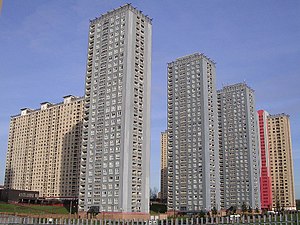
The only thing that worries me about Scottish independence is when I look out of the window where I am staying in Edinburgh, and I am reminded of the staggering inhumanity of some Scottish architecture.  

This apartment block is comfortable and sophisticated inside; outside it looks like a prison.  So does the next street, so does the next.  There are parts of Glasgow which include some of the most inhuman architecture I have ever seen anywhere in the world.

These monsters have been build during the union with England, so I don't suppose independence would make anything worse.  But my Scottish genes demand I make some kind of complaint about the way the city government of Scotland has, largely thanks to Labour control, made a terrible hash of mass housing....

Sunday, 18 August 2013

Come to Edinburgh to talk about the middle classes

Every summer in August, London's literary types decamp in a big coach for a small square in Edinburgh New Town, for the Edinburgh Book Festival - and very good it is too. Good atmosphere, good company, blue skies, nice grass to sit on. Rather wonderful, in fact.

I mention this because, as this blog is posted, I am speeding up to Edinburgh to joint them and to elucidate my book Broke: Who Killed the Middle Classes?, which remains the subject of some controversy.

I am very much looking forward to discussing the ideas in it with anyone who comes, at my event at the Book Festival at 4pm on 19 August. I am doing the event jointly with Richard Brooks, who has written a book called The Great Tax Robbery. So if you want to argue with me (or him), please come along.

There will the the added unknown to look forward to: how much defending the middle classes will go down with a Scottish audience. I am sure there will be civilised disagreement, but there is a part of me which worries that I may end up like Nigel Farage on his last visit to that city.

Do please come along and find out. I look forward to seeing you there.

Saturday, 17 August 2013

I have seen the future, and unfortunately it's Legoland

This week, two families were banned for life from Legoland Windsor for brawling with iron bars while they were queuing for the pirate ride.  The news does rather put Legoland into perspective.

It is one of those staggeringly expensive examples of an economy in microcosm that is dominated by monopolies and monopolistic concessions. 

That is why it costs so much to get in, at least £140 for a family of four, booking far in advance.  It is why it costs £2.90 per scoop of ice cream when you are there.  It is why you have to pay £2 just to leave the car park, let alone get in.

It works on the same principle of similar resorts, Centerparcs for example, where you can buy whatever you like – at great expense – as long as it is from Tesco.  They are kinds of prisons of pleasure.  I'm not surprised it drives people to violence.

It is why the queues are so long for the rides as well, and – because the English don’t understand what semi-monopolies do, and English politicians turn a blind eye – they take it out on each other with iron bars when they have to queue in the heat.

Now, I have huge respect for Lego.  It was started in 1932 by the Danish carpenter Ole Kirk Kristiansen , a dedicated pacifist.

The pacifist approach has now been 'finessed' by the new CEO from McKinsey, who turned round Lego’s fortunes with a series of film link-ups starting with Star Wars.  But the basic flexibility of the game remains: my children could survive on Lego without any other toys at all.

But in fact Legoland Windsor is only licensed by Lego, which sold all their parks in 2005.  It is actually run by Merlin Entertainments, a huge leisure behemoth based in Poole, which runs nearly 80 similarly expensive leisure ‘experiences’ on four continents – including most of their so-called rivals in the UK, Thorpe Park, Alton Towers, Madame Tussauds, Sealife centres, you name it.

My children have been pressurising me to go to Legoland.  I have even been collecting the One Adult Goes Free tokens from the sides of Kellogg’s packets, but was unable to find out from their website how you can use these to book cheaply in advance.

There is an information line but it is a premium rate 0871 number, of course.  There is another landline for customer service in the small print (01753 626182), but they don’t appear to answer their phone.

So I emailed the press office and, lo and behold, someone rang to give me the answer: you can’t book in advance using the Kellogg’s vouchers.


Still, the eye-watering expense of taking the family out for these is because Merlin Entertainments have too tight a hold on the entertainment resort market in this country.  Break them up, I say.  

If it was really made of Lego, I would break it up and make a new layout.