Perhaps it is even more significant that Labour backbencher George Mudie says he doesn't know what his party stands for, but Andy Burnham has caught the moment with his very public agonising - which amounts to much the same thing.
I have great respect for Andy Burnham. His summary of the fundamental problems of Westminster politics was spot on:
"I was schooled in this, kind of, 'how do we make a press release today that embarrasses the opposition?' That's the kind of politics that everyone was doing and the kind of culture developed where you're scrabbling over a bit of the centre ground with micro-policies that are designed to just create a little couple of days' headlines and create a feeling - but not change much else."
His solution is to merge health and social care under the auspices of the NHS. It is bold, and it plays to the Labour Party's old tradition - satisfying needs. He even sees the key problem of fragmentation in social care, which is has to be solved. He also recognises the importance of prevention, at least as far as good social care prevents people from turning up in primary care.
But there are three problems with this approach, brave as it is.
First, Burnham makes the same mistake as the coalition has made. He has not understood just how toxic the Blair-Brown legacy has been in public services, after a decade of target-driven centralisation, inflexibility and bone-headed IT investment along the lines laid down by McKinsey and others.
Health and social care do have to be merged, but they can't be merged using the existing system: it is built on the assembly line model and is not nearly effective enough at meeting people's real needs, not what the system thinks their needs are.
Second, Burnham includes no convincing analysis about why health and social care have been struggling, despite the ring-fencing of health services. Austerity might have been convincing, were it not for the fact that both systems have been increasing their costs much faster than the rate of inflation for years.
Is it an older population, more expensive drugs, or an increasingly alienated, isolated population, who receive treatment from the system as long as they remain passive? Any one of those requires some kind of analysis of how they can be tackled, or the costs of the new Greater NHS will rapidly overwhelm us - even after the austerity years.
It isn't enough to say that we just need to fund the current inflexible system better, with ever more central controls - in the Labour style - because people will not believe it, and they will be right not to. It was disastrous before. If they try and do it again, services will lose public trust.
But there is a third, more fundamental reason. Mudie was right: the Labour Party has not actually stood for anything much beyond positioning for some generations now, and their last period in power was presided over by a leadership which found it impossible to disagree with whoever was wealthiest or most powerful in any argument.
The party has long since ditched socialism, and according to the LSE, New Labour achieved no change in income inequality at all. In fact, they never tried.
The old Labour tradition (satisfying needs) is also problematic, given that - if satisfying needs is the heart of government, and the bureaucracy dedicated to that alone, then experience shows it tends to be deeply disempowering.
It is true, I am biassed against the Labour Party. I became interested in politics during the dull and reactionary Callaghan years, so I joined the Liberals. But Labour has still failed to develop an organising ideology. It means that when they take power, anything can happen.
I simply can't see the point of its continued existence.
I'm aware that I have said some related things about my own party sometimes. I'm also aware that my own party is in a coalition where their main power is simply to say 'no', on condition they don't do it very often. But I have been impressed by the discipline of the Lib Dem parliamentarians (far more so than their coalition partners).
I am kind of crossing my fingers that this may imply, despite all the difficulties and strains involved, that they have developed some underlying ideological coherence themselves.
Sunday, 11 August 2013


Saturday, 10 August 2013
Has change actually been slowing down?

Would the hapless Euro-MP Godfrey Bloom have
offended with the same remark about bongo-bongo land a generation ago - in,
say, 1967?
I have a feeling he would have done. Even the year before Enoch Powell's 'Rivers of
Blood' speech, and the dockers marching in his support, most of us in the UK would have found it tasteless and boorish, if not
offensive.
Though, it is a marginal call. Am I alone in remembering the lines of the
original signature tune to the BBC’s Start the Week, sung by Lance Percival,
and the line the follows “come to Bradford in
the sun”? (I won't say what I think it was in case my memory is
faulty).
The reason I have been wondering this is that I turned nine in
1967 and went for my birthday outing with a few friends to Chislehurst Caves
(where are you now, Adam, James, Justin...?).
I haven't been back since, until yesterday when, for my son's ninth birthday outing, I went again.
I wish I could say it hadn't changed at all. To be honest, I
didn't remember a great deal (though it was extremely satisfying, after all
this time, to wander around underground with an oil lamp).
What now feels like nostalgia was then more like
uncategorisable impressions, so it is hard to make comparisons. But I have been wondering whether really so much
has altered since then.
What has definitely shifted is social
attitudes, to sexuality and race – or at least how one refers to it in public –
and definitely in the role of women. IT
has also changed, but I wonder really whether that is as big a transformation as
we think it is, however wedded we are to the screen. We have also gained the concept of 'offensive' but at the cost of becoming more offended, more puritanical and so much narrower in public debate - but I was hardly taking part in pubic debate in those days, so I may be wrong.
I have a mobile phone, which I certainly never had in 1967,
but I probably watch less television – my children certainly watch very much
less than I did.
But apart from that, what has changed? In London, we have been working similar hours, going to the
same sports venues, and catching the same bus routes with the same numbers, for well
over a century. I have been travelling
in jumbo jets for my entire life. The
mini (see assembly line picture above from 1967) has been in production in Oxford since I was three - and it still is.
Doctor Who’s Tardis seems to be much the same as well.
Compared to the staggering technological changes of the
first two decades of the last century, when cars, submarines, aeroplanes and
cinema took giant leaps, to emerge fully formed around 1967, when the original
pioneers were often still alive.
More about this in my submarine ebook Unheard, Unseen.
All of which is my way of saying this: don't believe it when
people tell you that change is accelerating.
In the UK, it has actually been slowing down.
And there is an old dinosaur like Godfrey Bloom mouthing off to prove it.
Friday, 9 August 2013
How to make hospitals safe
Back in the 1940s, the great American theorist of ‘total quality’ W. Edwards Deming warned that assembly lines, in themselves, are not efficient at all. Hence the huge problems with safety and care that is causing the NHS such angst at the moment. Hence the effective campaign by Deming's vicar on earth, John Seddon, to reform public services away from the assembly line model.
Deming’s story is rather peculiar, because he found that his fellow Americans were not quite ready for this message, so he took his ideas to Japan after the Second World War, and was enormously influential.
Deming’s idea of tackling poor quality in factories was to use ‘quality circles’ of staff, where these issues could be discussed without blame, as Berwick suggests. In companies like Toyota, every member of staff famously has the power to turn off the assembly line whenever they see something wrong.
Deming’s story is rather peculiar, because he found that his fellow Americans were not quite ready for this message, so he took his ideas to Japan after the Second World War, and was enormously influential.
Efficiency is all about getting things right first time, he said, because then you don’t have to do it again. He was astonished at how much the American factory system wasted, in materials and time, just by failing to pay attention to quality. The result was the enormous sums of money were spent by organisations just to put right the mistakes they had made – and splitting up jobs means more mistakes.
“Let’s make toast the American way,” Deming used to say. “I’ll burn, you scrape.”
I've looked all the way through Don Berwick's report for the government on improving care standards in the NHS, and Deming's name doesn't appear at all. But his spirit is clearly abroad, because Berwick's commitment to openness and transparency, and an end to the blame culture, carries the Deming stamp.
“Let’s make toast the American way,” Deming used to say. “I’ll burn, you scrape.”
I've looked all the way through Don Berwick's report for the government on improving care standards in the NHS, and Deming's name doesn't appear at all. But his spirit is clearly abroad, because Berwick's commitment to openness and transparency, and an end to the blame culture, carries the Deming stamp.
More about Deming and Seddon in my book The Human Element. But back to the Berwick report. It got a good kicking from the influential NHS blogger Roy Lilley, and you can see why: there is a great deal of rhetoric in there - and if the NHS ran on rhetoric, hospitals would now be enjoying a hefty surplus.
It is one thing to say that care standards and safety should be the first priority of the NHS, but then nobody says it wasn't. The real question is how to guarantee and improve standards despite all the other pressures.
But Berwick, Obama's former health advisor, deserves more credit. The commitment to no-blame is a bold gear-change for the prevailing culture, which insists that mistakes and poor care are always the fault of someone in particular who must be disciplined, or even gaoled.
What Deming suggests, and what Seddon explains today, is that you can't under-rate the system. Whatever the rhetoric says, if the system encourages poor care by treating the NHS like an assembly line - that is what you will get: poor care and an assembly line.
Deming’s idea of tackling poor quality in factories was to use ‘quality circles’ of staff, where these issues could be discussed without blame, as Berwick suggests. In companies like Toyota, every member of staff famously has the power to turn off the assembly line whenever they see something wrong.
Three decades later, it was clear that Japanese industry was a good deal more efficient and effective than their American competitors. Yet it wasn’t until 1978 that Deming began to have any impact on his own country. Ten years later, there were 50 Deming societies across the USA.
Twenty years later, they were gone again. Quality circles were not an innovation that the IT consultants could earn much from, and quality management was quickly swept away by ‘Re-engineering’, and all the rest of the disastrous McKinseyite mush of controlling IT systems and one-dimensional measures.
Those who believe that industrial assembly lines can be applied to all human work were once more in control, and with disastrous results. That is why Berwick's report is potentially important: it has provided a potential antidote to the sick targets and compliance system: transparency and commitment to quality.
He even, sensibly rejected, compulsory candour - a rule where you have to tell patients about mistakes - because he knew the bureaucracy would kick in and regulated candour would substitute for good care.
This isn't about IT. It is about human skills and human co-operation. Despite the rhetoric, not because of it, Don Berwick's report could turn out to be important.
Thursday, 8 August 2013
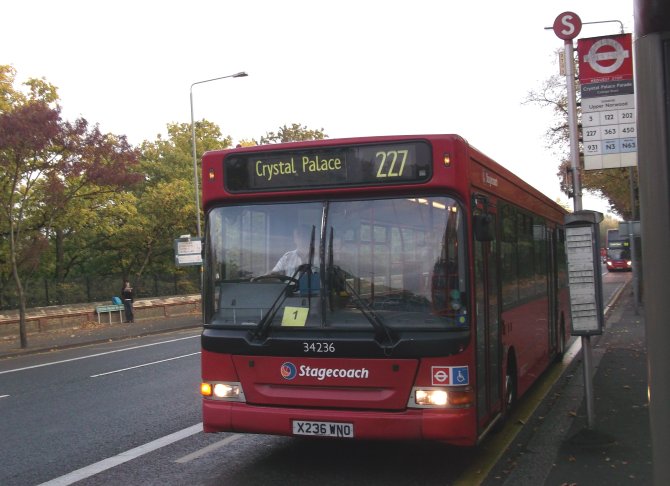
Is the 450 bus the solution to public service intractability?

There is a kind of experiment you can do with public services where I live in Crystal Palace, and I was reminded of it today when the bus driver for the 450 waved at me as he drove by. I wondered at the time whether it might be part of my answer for Mark Pack (see below).
There are lots of buses where I live. If I get the 450, it is a small single-decker bus. It is usually packed full of pensioners hanging onto the supports for dear life as the driver swings them round. When everybody gets off, young and old, they often thank him. If somebody very old is clambering aboard, someone usually leaps off and helps them on. Sometimes the driver does. People also chat to each other, which is very unusual, even in Crystal Palace.
But if the 468 comes first, it is a different experience. It is the same cross-section of passengers, but this is one of those broad red double-decker buses, the motoring equivalent of a brontosaurus, making a meal of its own tail. The atmosphere is completely different: nobody talks. Nobody even smiles. Nobody speaks to the driver, though he occasionally swears at us. Nobody helps anyone on or off. You can cut the distrust with a knife.
I have thought about this a great deal. It isn’t that there are more regulations on the smaller bus; the driver ignores them anyway. The government doesn’t regulate smaller buses more intensely. It is subject to no extra government targets or funding for social cohesion. The passengers have undergone no extra community training.
Nor are there extra targets which the 450 keeps in neighbourliness and humanity, or even special surveys of how happy the passengers are.
No, I think the success of the 450 is more about its size. It is smaller and, because it is smaller, the drivers’ human factor comes into play. We are aware of them as people: they can – and often do – make people’s day.
No, I think the success of the 450 is more about its size. It is smaller and, because it is smaller, the drivers’ human factor comes into play. We are aware of them as people: they can – and often do – make people’s day.
On the 468, the poor benighted drivers are forced to be adjuncts of their machines. Like the policeman in Flann O’Brien’s novel The Third Policeman, they are already part metal. “Size seems to make many organisations slow-thinking, resistant to change, and smug,” said the great investor Warren Buffett in his 2007 letter to shareholders. He was talking about companies, but it applies equally well to buses. Or services.
This is not definitive. The 450 and 468 don’t follow exactly the same routes; one route might involve more schoolchildren – but the phenomenon is instantly recognisable.
This is not definitive. The 450 and 468 don’t follow exactly the same routes; one route might involve more schoolchildren – but the phenomenon is instantly recognisable.
We know from personal experience that there are knock-on human effects when systems get bigger. We have all stood behind an elderly customer at the supermarket checkout trying to chat with the cashier about the weather – just as she used to when the small shop was there – while the queue behind taps its collective feet. We know what happens when organisations are too big: the systems take over.
We know, in fact that organisations built on an inhuman scale, with their inhuman architecture, and terrifying marble lobbies, don’t find it so easy to provide the kind of simple regime that allows human beings to make things happen. That is why, if we want our organisations to work more effectively, we have to end the tendency of all of them to strive towards empire. More on this in my book The Human Element.
So that is my partial answer to Mark Park.
We know, in fact that organisations built on an inhuman scale, with their inhuman architecture, and terrifying marble lobbies, don’t find it so easy to provide the kind of simple regime that allows human beings to make things happen. That is why, if we want our organisations to work more effectively, we have to end the tendency of all of them to strive towards empire. More on this in my book The Human Element.
So that is my partial answer to Mark Park.
For this reason, I was fascinated by his very clear exposition of the problem - or at least part of the problem - with the story he told about the scaffolding up the side of his house which has been there for years, and which even resulted in a gagging order preventing him from naming names. It definitely repays reading.
Mark's solution to this staggering inefficiency, by the local authority, is at least partly right - he wants some kind of measure of how happy with the service people are to replace the dysfunctional targets that still tie our services in such knots after the New Labour years. In short, he wants something like the new Friends and Family test in the NHS.
But to really tackle the problem, we need to somehow define the basic problems that public services face now, and I think there are three of them:
1. They cost more than we can afford, even without austerity, and the costs are rising (see the Graph of Doom) without having any strategy to prevent future illness, ignorance, want etc.
2. The extreme inflexibility (and therefore relative ineffectiveness) of the service system as currently organised - partly the legacy of the New Labour years. This is also the cause of the gap between the management of services and the people who use them.
3. Their extreme complexity makes them difficult to manage effectively.
Now, you can be too glib about this, and I am about to be. But at least part of the problem here is the same problem as the 468: it is too big, the driver is miles from the engine so he can't pick up the subtleties, and nobody takes much responsibility for the other people on the bus (least of all the driver).
The solution? Much smaller units, less hierarchy, people who can build relationships with those they are supporting and, above all, simpler systems so that staff can not just feel responsible for the costs of scaffolding abandoned for years - but actually do something about it.
Wednesday, 7 August 2013
A 'modest proposal' from McKinsey

[Paul Nash's painting 'Still Life with Shale Gas']
Yes, the global economy has had its difficulties, an unpredictable blip in the rising success of market economics, the result of a series of misjudgements by [INSERT NAME OR SECTOR]. But support for recovery is on its way in the form of a revolutionary technique, involving pumping deadly chemicals below our gardens, potentially earning huge sums.
In the USA, pumping these chemicals has grown more than 50 percent annually since 2007. The chemical pumping boom could add as much as $690 billion a year to GDP and create up to 1.7 million jobs across the economy by 2020. The impact will extend to energy-intensive manufacturing industries and beyond.
As always with profitable new manoeuvres, there is a small minority of naysayers, who are ignoring the extraordinary benefits to the economy - and to the poor - because they selfishly want to protect their homes and land from the benefits of future wealth. We are confident that these misunderstandings are based on an unfortunate ignorance of the economics. The potential profits are great enough that we can expect some of them to trickle down and compensate people for their ruined and poisoned landscape.
You can't stand in the way of progress, and we look forward to an era of chemical pumping, monetising huge wealth for future generations. What non-economists fail to recognise is that, they may be living in a poisoned landscape (see artists impression above), but the wealth locked up in the land will be released for them and their children to spend on washing machines, giving them real choices which they would not otherwise have dreamed of.
After all, we are now growing hamburgers in test-tubes and no longer require outdated medieval concepts like 'land', when we can have a virtual version that will be in many ways better.
After all, we are now growing hamburgers in test-tubes and no longer require outdated medieval concepts like 'land', when we can have a virtual version that will be in many ways better.
I am aware that this econ-babble is the most appalling nonsense, but it is worth spelling out what we are being asked to believe.
It is true that the ubiquitous management consultants McKinsey did not put their support for fracking quite like this, though there are echoes in their latest pronouncements on the five opportunities for the US economy. They did at least recognise there were environmental issues which had to be solved, which at least goes further than the most bizarrely short-sighted cheer-leaders like Nigel Lawson.
It is true that the ubiquitous management consultants McKinsey did not put their support for fracking quite like this, though there are echoes in their latest pronouncements on the five opportunities for the US economy. They did at least recognise there were environmental issues which had to be solved, which at least goes further than the most bizarrely short-sighted cheer-leaders like Nigel Lawson.
Yet McKinsey is probably more responsible for the current state of the world than any similar organisation. Their fatal reliance on one-dimensional measurement, central control and bone-headed pseudo-markets is one of the main reasons that UK public services are so staggeringly expensive, at the same time as being so staggeringly ineffective.
So I had to have a look at their prescriptions for future growth. Fracking was one. The others were:
- Making the US economy more competitive in knowledge intensive industries. They estimate that global airline fleets will double by 2031. I don't think so. Not if climate change turns out to be significant.
- Big data analytics for productivity: Well, yes, but only if the big data systems set frontline staff free to innovate and use the knowledge as they see best. Thanks to McKinsey, most big data systems rely on rigid collection mechanism, linked to reward systems that render the data meaningless. In other words, the benefits of big data have to be weighed against the McKinseyite costs of central control.
- More investment in infrastructure: Well, yes, but once again this is based on those one-way cost-benefit analyses that only counts the benefits and ignores the costs. More roads will tend to favour big business against small, and may simply destroy local jobs, and replace them with half as many corporate replacements - leaving many areas increasingly dependent on the centre.
- More effective talent development. You can't argue with that, until you come to the sentence: "introducing digital learning tools can boost student achievement." But only alongside a close human relationship with a teacher; digital learning tools without a face-to-face relationship will tend to spread ignorance and one-dimensional knowledge.
In other words, McKinsey still seems to be committed to the same old mistakes: centralised data systems, centralised distribution systems and learning without transformative relationships. It doesn't work.
Worse, it is based on one-dimensional knowledge, and only one-dimensional knowledge - with the most simplistic and misleading bottom lines - could possibly make it worthwhile to poison the landscape to gorge ourselves briefly on shale gas.
Tuesday, 6 August 2013
Smaug and the bankers

The novelist John Lanchester has built up a formidable knowledge of banking for a non-banker and is wielding the results regularly in the London Review of Books, which I have just started reading and very much enjoying (thank you, Jonathan!).
In fact, his latest article 'Let's consider Kate' succeeded in changing my mind completely about bank regulation. I had become so focused on the way that the investment banks are corroding the real economy that I had come to believe that regulation was an irrelevance, compared to building an effective local banking system.
Lanchester remains focused on the threat of a second bank failure - which is only too possible - and what that could do to civilisation. And of course he is right.
But the great advantage of getting a creative writer to look at these issues is that he can bring the facts alive in a way economists - with the possible exception of Keynes and Schumacher - generally fail to do (Keynes pinpointed Schumacher as his successor because of his ability to make the figures 'sing').
Lanchester has been pointing out the effects of the compensation paid out by the banks for their failures selling payment protection insurance, explaining that these sums have had more impact on the real economy than all the failed Funding for Lending schemes, and he conjured a wonderful image of the banks like Smaug, with their piles of gold, opening an occasional greedy eye.
It was with this image in mind that I read reports yesterday where HSBC chairman Douglas Flint promised to find ways of getting around EU bonus caps (100 per cent of base salary, or 200 per cent if shareholders agree), so that they could pay 'fair' bonuses to bankers in their non-EU operations. HSBC chief executive, looking a little like Smaug in the photographs, says that the 'new rules' would be highly damaging to them, because they need to be able to compete in local markets.
I see his point, but the bonuses are corrosive in other countries, just as they are here. They create inflation for the rest of us, and property inflation in particular. They are a perverse instrument for management in any situation and, in banking, they can still destroy - as they effectively did last time by making the sub-prime crisis possible. This is a global problem, not just an EU one.
Peering into the thoughts of HSBC confirms how perverse and dangerously remote from the real world the high command of banking has become.
But the picture of Smaug will stay with me, and the blackened destruction that dragons wreak on the cities of men when they arrive there. Because the truth is, we still live in the shadow of a new Desolation of Smaug.
Monday, 5 August 2013
The euthanasia of the British way of life

Regular readers of this blog (if there are any) may have noticed, if they were particularly observant, that I have't managed to keep up my usual, how shall I say, rhythm, over the past week. That is because I've been on holiday on a very small farm in Normandy.
We found the gite through the website Accueil Paysan, which gives people the chance to stay on small farms, and which apparently the English very rarely use - though their cars and accents are very much in evidence in the local town, Port-Bail. This is rather strange, because that kind of holiday seems almost impossible now in the UK - with the hens and ducks everywhere - because everything has been made so miserably tidy.
A week on the farm, watching the cows being milked by hand every evening, has made me feel extraordinarily relaxed. But here I am back in London, blogging again.
What I took away from the week was a bit of a conundrum. How come that way of life is still a option in France, when it isn't in the UK?
The broader answer is partly to do with the French way. If you need fresh bread every morning, you don't want to go to a out of town shopping centre to get it - and Amazon won't really do either. You will necessarily support a very local of network of boulangeries, with all the economic implications of that.
But how come small-scale agriculture remains possible in France? The farm where we stayed made a great deal of yogurt, and sold rabbits and eggs, and occasionally pigs as well. The farmer had only recently bought it, so there was presumably a mortgage on the farm too - so this was not free of debt.
It was an exhausting life, but he had chosen it and it was possible to see why.
There may have been subsidies from the CAP which underpinned the prices he was paid. The French have not allowed their supermarkets to gut the small- farms sector as we have. But, as in the UK, it is large-scale farming the gobbles up most of the agricultural subsidies in France.
No, I became convinced that it was the price of property and land that made the difference. The French have not turned their property into asset bubbles, under the mistaken impression that they represented wealth. So a civilised life on the land is still an option.
UK small business will be paying a hefty chunk of their income just to pay an insane mortgage. The Chancellors agonises about the weight of energy costs on business, and seems to be prepared to grub up the nation and frack the land to keep it low. But the much larger weight that lies so uselessly on business, extracted by the bank to pay off the mortgage, apparently doesn't worry him.
The true cost of our four-decade property bubble, and how it is taking property out of reach of the vast majority of people in this country a little more every day, is one of the main themes of my book Broke: Who Killed the Middle Classes?
As I think about the prospects for my own children - priced out of the neighbourhoods where they were born - commuting like gastarbeiter for hours every day to work, and paying huge proportions of their meagre earnings on rent - this makes me increasingly angry.
There will come a time when people wake up to the reality: that property prices are ruining us - and then perhaps we can begin to do something about it. But hasn't happened yet.
In the meantime, it was good to spend a week where the euthanasia of a civilised life for ordinary people has been happening rather more slowly.
Subscribe to:
Posts (Atom)